
Human-in-the-Loop AI Agents: A Production Guide to Balanced Automation
Fully autonomous AI agents promise speed and scale, but in production environments, pure automation is rarely enough. High-stakes decisions — financial transactions, compliance checks, customer data changes — require human judgment that no model can fully replicate. Human-in-the-Loop (HITL) design patterns solve this by embedding structured oversight checkpoints into agent workflows, giving you the speed of automation with the accountability of human review.
This guide covers the four proven HITL patterns, how to choose between them, implementation strategies for production systems, and common pitfalls to avoid. Whether you are deploying your first agent or scaling a fleet, these patterns provide the governance framework modern regulators and risk teams require.
Why AI Agents Need Human Oversight in Production
Three failure modes appear when agents operate without structured human checkpoints:
- Hallucinated actions: An agent confidently executes a workflow based on fabricated information, and no human reviews it before the action takes effect.
- Permission misuse: An agent accesses systems or takes actions beyond its intended scope, and no access review catches the overreach.
- Audit failures: A regulator asks who approved this automated decision, and the organization cannot produce an answer because no approval checkpoint existed.
Regulatory pressure is accelerating the need for governance. The EU AI Act Article 14 requires high-risk AI systems to be designed so people can effectively oversee them while in use, with fines reaching 15 million euros or 3% of global turnover for non-compliance. According to a Dataiku and Harris Poll survey of 800+ data leaders, only 5% report that AI output is traceable 100% of the time. That gap between capability and auditability is where HITL patterns create real value.
Four Human-in-the-Loop Design Patterns
1. Interrupt and Resume
The agent pauses execution at a predefined checkpoint and waits for human approval before continuing. The human receives the agent’s proposed action, the context that led to it, and the authority to approve, modify, or reject. This pattern creates a point-in-time checkpoint with a documented decision record — the audit trail shows what the agent proposed, what the human approved, and when.
Best for: High-stakes, low-frequency decisions where review time is justified by risk — financial approvals, customer-facing actions, and compliance-sensitive operations.
Trade-off: It adds latency for as long as it takes a human to respond. During that pause, the workflow is blocked.
2. Human as a Tool
The agent treats the human as one of its available tools and calls the human when it encounters uncertainty, ambiguity, or a task outside its confidence threshold. The human provides input, and the agent incorporates it into its reasoning and continues automatically.
Best for: Ambiguous decisions where the agent itself can flag uncertainty — data entry verification, context gathering, or tasks requiring domain knowledge the agent lacks.
Trade-off: It depends on agent calibration. An overconfident agent may not call the human tool. An underconfident agent may call it constantly, creating friction.
3. Approval Flows
A policy-driven approval system evaluates every agent action against defined rules and routes those requiring approval to the appropriate reviewer based on role, action type, and risk level. This creates a defensible audit trail with policy-based justification — every approval decision references the policy that triggered it.
Best for: Policy-governed actions in regulated environments where every decision must reference an explicit rule.
Trade-off: Policy design complexity. Poorly designed policies create bottlenecks (too many approvals) or gaps (too few). Policy testing and iteration are ongoing requirements.
4. Fallback Escalation
When an agent’s confidence drops below a defined threshold, it escalates to a human through asynchronous channels — Slack, email, or dashboard notification — rather than pausing execution. The agent may continue with a safe default action while the escalation is pending, or pause only the uncertain portion of the workflow.
Best for: Edge cases that fall outside the agent’s normal scope, where synchronous blocking would hurt throughput.
Trade-off: Asynchronous escalation means the human may not review the decision before the agent has moved on, if configured with a safe default. For irreversible actions, synchronous interrupt-and-resume is safer.
Choosing the Right Pattern: Decision Framework
The right pattern depends on three variables: the risk level of the decision, the latency tolerance of the workflow, and the availability of qualified reviewers.
Decision Matrix
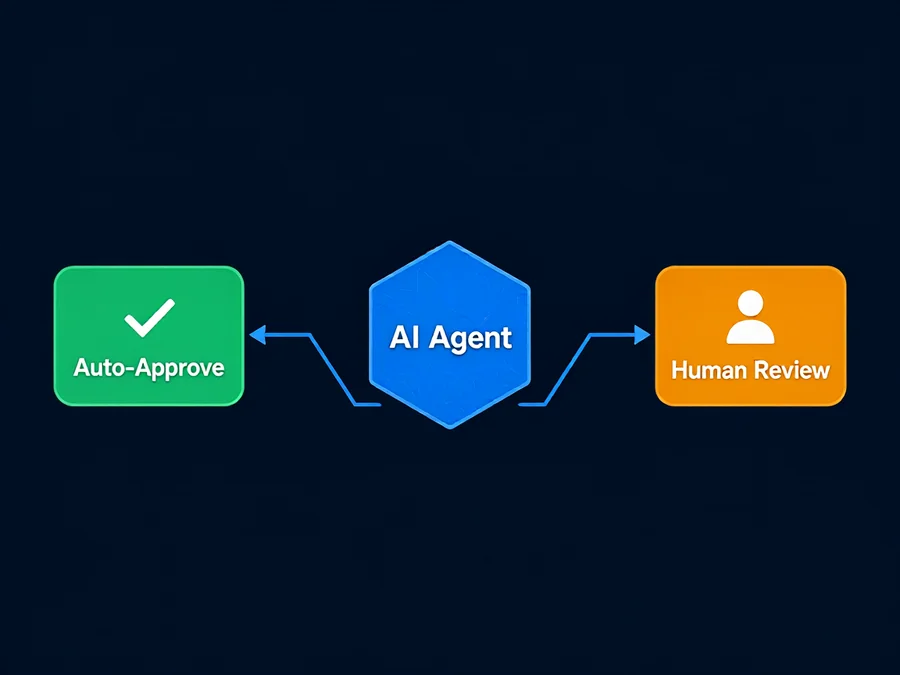
| Risk Level | Latency Tolerance | Recommended Pattern |
|---|---|---|
| High — irreversible financial impact | Low — can wait hours | Interrupt and Resume |
| Medium — reversible with audit trail | Medium — minutes acceptable | Approval Flow |
| Low — auto-correctable | High — must be near-real-time | Fallback Escalation |
| Variable — depends on context | Depends on case | Human as a Tool |
Implementation: Six Steps to Production-Ready HITL
Step 1: Map High-Risk Actions and Required Checkpoints
Inventory every action the agent can take, then classify each one by risk level: low, medium, or high. Once high-risk actions are identified, define what oversight each needs — whether that is synchronous approval, asynchronous notification, or simply logging the action for later review.
Step 2: Choose Design Patterns Per Checkpoint
Match each risk level to the pattern best suited to it. Interrupt and resume works well for high-stakes irreversible actions. Human as a tool fits ambiguous decisions where the agent flags uncertainty. Approval flows handle policy-governed actions. Fallback escalation covers edge cases outside all three.
Step 3: Select and Wire Frameworks
With the patterns chosen, select frameworks that match your existing stack. LangGraph supports interrupt-and-resume checkpoints for stateful workflows. CrewAI and HumanLayer support human-as-a-tool patterns. Permit.io supports policy-driven approval flows. For enterprise-scale governance, platforms like Dataiku provide Agent Review, approval workflows, and immutable audit trails.
Step 4: Define Policy Rules and Approval Roles
Document which roles can approve which action types. Where the stack supports it, implement those rules as policy-as-code so teams can test and version them alongside the agent code. Role segregation is critical — the person who builds the agent should not be the person who approves its production behavior.
Step 5: Build Immutable Audit Logging
Every approval, override, and escalation must be logged immutably. The log should capture who approved, what was proposed, what was decided, when, and which policy triggered the checkpoint. This log is your primary evidence for regulatory audits and internal incident reviews.
Step 6: Define Escalation Paths for Edge Cases
Edge cases that fall outside the agent’s scope and the standard approval flow need a clear escalation path. Define what happens when no policy matches, when the human reviewer is unavailable, and when the agent’s confidence is near-zero across all dimensions.
Real-World Use Cases
Financial Services
Loan approval is a classic HITL use case. An AI agent can validate application data, check credit scores, and generate an initial decision with a confidence score. High-confidence auto-approvals flow through automatically. Borderline cases — unusual income patterns, incomplete documentation, or cultural name mismatches — route to a human loan officer for review. The agent never makes the final decision on escalated cases; it presents the evidence and waits.
Healthcare
AI agents can triage patient data, flag anomalies in lab results, and draft preliminary assessments. But diagnosis and treatment recommendations always require physician sign-off. The HITL checkpoint here is not a bottleneck — it is a safety requirement. The agent handles the data synthesis; the doctor provides the clinical judgment.
Content Moderation
Automated filters catch obvious spam and harmful content at scale. But satire, cultural nuance, and contextual edge cases require human review. A common pattern: the agent auto-removes content above a clear violation threshold, queues borderline content for human moderators, and logs everything for compliance review.
Common Pitfalls to Avoid
- Too many checkpoints: A workflow with excessive approval steps becomes slower than the manual process it was meant to replace. Start with high-risk actions only and expand deliberately.
- Calibration drift: Agent confidence thresholds shift as models and data distributions change. Re-calibrate periodically or the human-as-a-tool pattern will either under-call or over-call reviewers.
- No escalation path: When an agent cannot decide and no policy matches, the workflow should not hang. Define a default safe action or a manual escalation queue.
- Weak audit trails: If your log does not capture who approved what and when, you have no defense in a regulatory review. Make immutability a hard requirement, not an afterthought.
- Single point of failure: If one human reviewer is the only approver for a critical action type, their absence halts the entire workflow. Build reviewer rotation and backup approval paths.
Measuring HITL Effectiveness
Track these KPIs to evaluate whether your human-in-the-loop design is balanced:
- Auto-approval rate: The percentage of actions processed without human review. Target 70–90% for well-calibrated systems.
- Mean time to human resolution: How long escalated decisions wait for reviewer action. Track per-risk-tier.
- Override rate: The percentage of agent proposals that humans modify rather than approve as-is. High override rates suggest the agent needs better context or calibration.
- Escalation volume trend: Rising escalations over time may indicate model drift or expanding agent scope beyond its trained boundaries.
- Audit readiness score: The percentage of agent actions with complete, immutable approval records. Should approach 100%.
FAQ
Can human-in-the-loop AI agents still operate efficiently?
Yes. Efficient HITL design automates low-risk actions entirely, uses asynchronous channels for medium-risk decisions, and reserves synchronous approval for high-stakes actions only. In many deployments, only a small share of decisions require human review — typically 10–30% for well-calibrated systems.
What is the difference between human-in-the-loop and human-on-the-loop?
Human-in-the-loop means the agent actively pauses and waits for human input before proceeding. Human-on-the-loop means the agent runs autonomously but a human monitors and can intervene if something goes wrong. The former is synchronous and blocking; the latter is asynchronous and supervisory.
How do you calibrate an agent’s confidence threshold for human escalation?
Start with a conservative threshold and validate against historical decisions. Track the override rate and adjust upward if humans approve most proposals, or downward if too many borderline cases reach reviewers. Re-calibrate whenever the underlying model changes or the agent’s data sources shift.
Is HITL required for compliance with the EU AI Act?
The EU AI Act Article 14 requires demonstrable human oversight for high-risk AI systems. HITL patterns are the primary mechanism for meeting this requirement. The obligations apply from December 2, 2027 for standalone high-risk systems and August 2, 2028 for AI embedded in regulated products.
Which frameworks support human-in-the-loop patterns?
LangGraph provides interrupt-and-resume checkpoints for stateful workflows. CrewAI and HumanLayer support human-as-a-tool patterns. Permit.io enables policy-driven approval flows. Enterprise platforms like Dataiku offer Agent Review, lifecycle tracking, and immutable audit trails for governing agent fleets at scale. For SmaugBrain users, the agent framework’s built-in task interruption and skill-based tool calling provide natural foundations for HITL implementation.
Can multiple HITL patterns work together in one workflow?
Absolutely. A production deployment often layers several patterns: interrupt-and-resume for high-stakes financial actions, human-as-a-tool for ambiguous data queries, approval flows for policy-governed operations, and fallback escalation for edge cases. The key is mapping each pattern to the risk tier it best serves.
Getting Started With SmaugBrain
SmaugBrain provides the infrastructure for building production-ready AI agents with built-in human oversight capabilities. From skill-based tool calling to multi-agent orchestration, the platform supports every HITL pattern described in this guide. Whether you are designing a single agent with approval checkpoints or orchestrating a fleet of governed agents across your organization, SmaugBrain gives you the tools to ship safely.
Explore the platform and start building your first governed agent workflow today.