
Building AI agents that work reliably in production requires more than a working prototype. The gap between a demo that succeeds 9 out of 10 times and a system that delivers correct outcomes under real-world conditions is where most teams stumble. This guide covers the reliability engineering practices that separate production-grade AI agents from brittle prototypes.
What Makes AI Agents Uniquely Fragile
Traditional software follows deterministic logic paths. An if-statement either evaluates true or false. AI agents introduce non-determinism at every layer: model inference produces variable outputs, tool responses depend on external systems, and orchestration decisions compound uncertainty across multiple steps. A failure in one component doesn’t just return an error — it can silently produce an incorrect result that looks plausible enough to propagate through the entire workflow.
The problem intensifies with compound AI systems. When you chain retrieval, generation, tool calling, and decision-making into a single autonomous loop, failures multiply across component boundaries. Research analyzing 150 production incidents found that 51% involved silent degradation — the system continued producing outputs that passed all health checks but were actually wrong. These are the hardest failures to detect and the most damaging to trust.
The Five Core Failure Categories
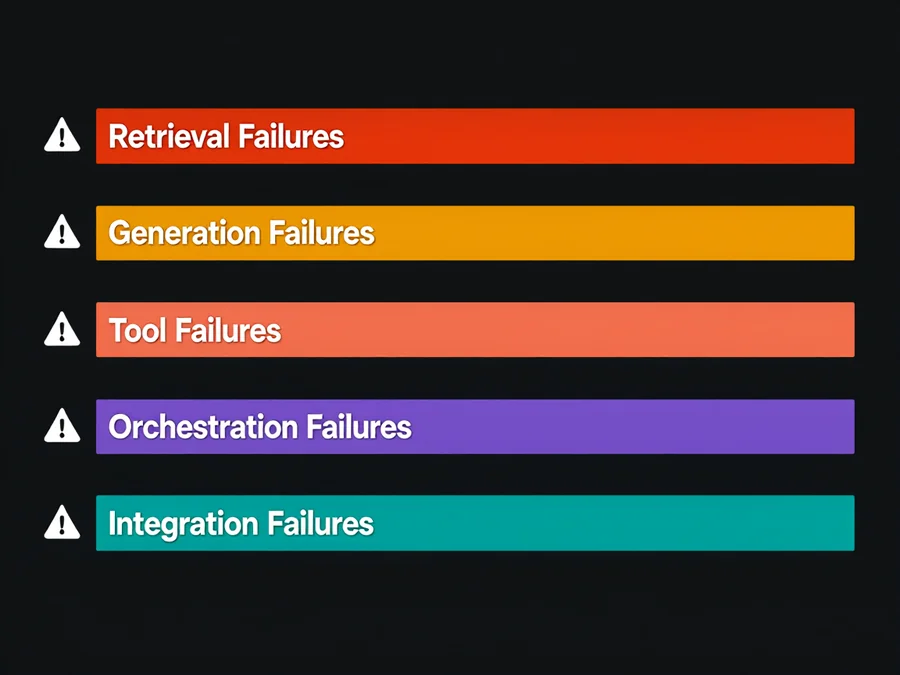
Understanding where failures originate lets you design defenses at the right layer. Production incident analysis consistently reveals five fault categories:
| Category | Description | Detection Pattern |
|---|---|---|
| Retrieval failures | Knowledge sources return irrelevant, stale, or incomplete data | Retrieval relevance scores drop below threshold |
| Generation failures | Model produces incorrect, hallucinated, or off-scope content | Output quality gate flags semantic inconsistency |
| Tool failures | External tools error, timeout, or return malformed responses | Tool response validation rejects input |
| Orchestration failures | Decision loops enter bad states — retries, oscillation, context exhaustion | Step count exceeds bounded limit; no-progress detected |
| Integration failures | Component interfaces break between upgrades or version drift | Typed interface contracts fail validation |
Each category demands a different defensive strategy. Treating all failures as “the model made a mistake” misses the structural causes and leads to fragile patches rather than systematic hardening.
Resilience Patterns That Move the Needle
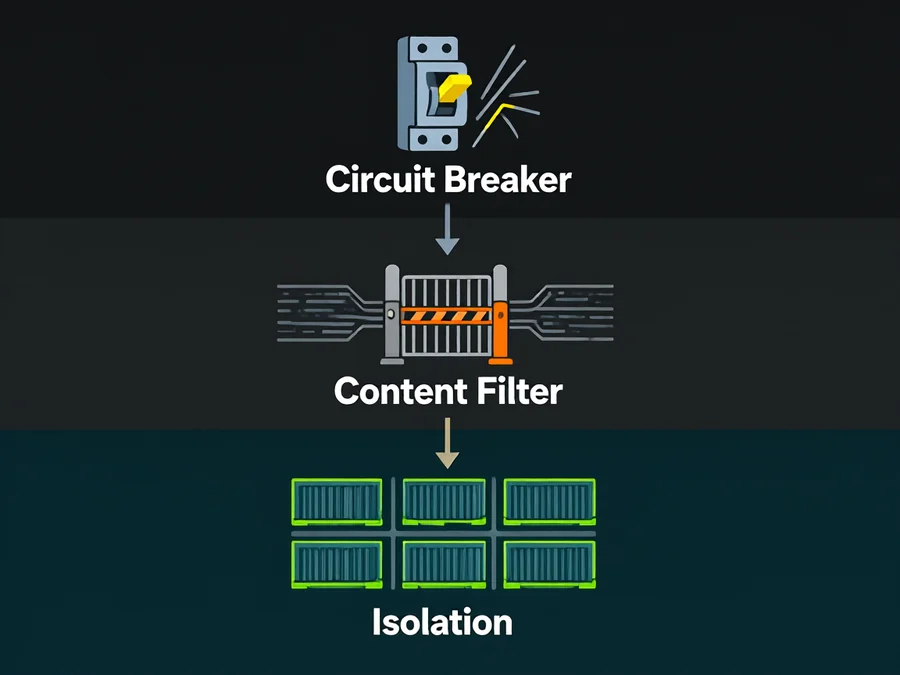
Not every failure pattern deserves equal investment. Fault injection studies measured the impact of common resilience patterns on actual production behavior. The following patterns show quantifiable effectiveness when implemented together:
Circuit Breakers for Cascade Containment
Circuit breakers adapted from distributed systems engineering reduce cascade propagation by 89%. The key adaptation for AI systems is monitoring semantic quality metrics — not just HTTP status codes. Most AI failures return 200 OK with degraded content. A breaker should track output coherence scores, retrieval relevance thresholds, and tool response validity rates alongside traditional latency and error counts.
When the failure rate exceeds your threshold (five errors in 30 seconds is a reasonable starting point), the breaker opens and downstream components receive structured fallback responses instead of waiting for timeouts. This reduces mean cascade depth from 3.8 components to 0.4 components, containing damage to the failing boundary rather than letting it propagate through the entire agent loop.
Output Quality Gates
Quality gates catch 73% of silent degradation before user impact. Instead of trusting the model to self-correct, validate outputs against explicit constraints at each stage. Semantic validators check that generated content matches expected structure, factual claims align with retrieved evidence, and tool inputs satisfy typed interface contracts. For code generation agents, this means syntax validation and basic logic checks before execution. For classification tasks, confidence thresholds prevent low-certainty predictions from reaching users.
Component Isolation
Isolation reduces blast radius by 64%. Each agent component — retriever, generator, tool executor, orchestrator — should operate within defined fault boundaries. Deploy independent components across separate processes or availability zones when possible. Use strict request-response schemas with validation at every boundary. When one component fails, the isolation layer prevents state corruption from spreading to unrelated services.
Semantic Validators
Semantic validators caught 81% of semantic errors in controlled experiments. Unlike format validators that check JSON structure, semantic validators understand meaning. They verify that dates are chronologically consistent, numerical values fall within expected ranges, cross-field constraints hold, and generated responses address the original intent. Implement these as lightweight post-processing checks rather than expensive re-runs through the full model pipeline.
Typed Interface Contracts
Typed interfaces reduce integration failures by 92%. Define strict schemas for every tool call and MCP server interaction. Version your contracts explicitly. Validate incoming tool responses against the contract before passing them downstream. When upstream services change their response format, type violations surface immediately rather than producing subtly wrong results that pass all other checks.
Systems implementing three or more of these patterns reduce mean-time-to-recovery by 71% compared to unstructured monitoring baselines. The combination matters: circuit breakers contain cascades, quality gates detect silent degradation, and component isolation limits blast radius. No single pattern addresses all failure modes.
Measuring What Matters: Reliability Metrics
Defining reliability targets requires measuring beyond accuracy percentages. Accuracy tells you whether the model gets individual answers right. Reliability tells you whether the complete system delivers correct outcomes consistently under production conditions.
Recovery Rate
After an error, interruption, stale state, or changed environment, how often does the agent recover and finish safely?
Track both automatic recovery success and escalation-to-human frequency. Target recovery rates above 95% for routine workflows. Lower targets may be acceptable for high-complexity tasks where human judgment is genuinely required.
False Completion Rate
How often does the agent report success without valid outcome evidence?
This includes cases where the agent completes all steps but produces incorrect final output, or where it claims completion while leaving external systems in inconsistent states. False completions erode trust faster than any other failure mode because they leave no visible error signal.
No-Progress Rate
How often does the agent repeat tools or reasoning without advancing toward the task goal?
Oscillation between two tools, infinite retry loops, and context window exhaustion all manifest as no-progress behavior. Set step-count budgets and monitor for repetition patterns in the action history.
Severity and Blast Radius
How consequential are failures involving money, permissions, customer records, security boundaries, or public artifacts?
Classify workflows by failure severity — a translation task has different risk tolerance than a financial transaction agent. Design stricter validation and human-in-the-loop checkpoints for high-severity categories.
Cost and Latency Per Completed Task
What does successful work cost after accounting for retries, recovery paths, and failed attempts?
Include the overhead of resilience mechanisms in your budget calculations. A system that recovers from 10% of failures but triples per-task cost may not be economically viable. Optimize for total cost of reliable delivery, not just happy-path efficiency.
Escalation and Human Repair Frequency
How often does the agent hand off to humans or require manual state repair?
High escalation rates indicate either overly aggressive autonomy boundaries or insufficient error recovery. Track both intentional escalations (designed handoffs) and emergency escalations (agent stuck requiring intervention).
Building a Reliability Budget
Set a reliability budget for each meaningful workflow or traffic slice. Define a task-success floor, a maximum false-completion rate, hard limits for high-severity failures, and tolerances for cost, latency, escalation, and recovery before a regression appears. Treat these budgets like SLAs for internal systems — breach them and the release doesn’t ship.
| Workflow Type | Success Floor | Max False Completion | Recovery Target |
|---|---|---|---|
| Read-only Q&A | 98% | 0.5% | 95% |
| Data transformation | 95% | 1% | 90% |
| Transactional | 99% | 0.1% | 98% |
These thresholds are starting points, not universal rules. Calibrate based on your domain requirements and user expectations. The process of defining budgets forces clarity about what “working reliably” actually means for each workflow.
Failure Injection Testing
Resilience patterns are only as strong as the testing that validates them. Standard load testing won’t reveal agent-specific failure modes. You need AI-specific failure injection that simulates the conditions agents actually encounter:
- Simulate model inference failures by returning garbled responses or forcing timeout errors
- Introduce knowledge base inconsistencies by serving outdated or contradictory documents
- Inject tool response delays and partial failures to test recovery paths
- Vary context window sizes to identify degradation patterns under constraint pressure
- Modify input distributions to surface edge cases the training data didn’t cover
Run these tests periodically and after every significant change to models, tools, or orchestration logic. The goal isn’t perfect scores — it’s measuring whether resilience patterns catch failures before users do and whether recovery paths execute correctly under realistic conditions.
Practical Implementation Checklist
Before declaring an AI agent production-ready, verify these items:
- [ ] Every tool call has a typed interface contract with runtime validation
- [ ] Circuit breakers configured with semantic-quality thresholds, not just HTTP codes
- [ ] Output quality gates at each generation stage with configurable confidence thresholds
- [ ] Step-count budgets and no-progress detection preventing infinite loops
- [ ] Component isolation boundaries with independent error handling per layer
- [ ] Recovery paths tested through failure injection for top-5 failure modes
- [ ] Reliability metrics dashboard tracking all six measurement dimensions
- [ ] Escalation procedures defined for each severity level with clear handoff criteria
- [ ] State consistency validation on completion verifying external systems are left intact
- [ ] Rollback procedures documented for transactions that modify persistent data
Meeting fewer than eight of these items indicates the system is still in prototype territory. Full compliance across all ten establishes a foundation where reliability improvements compound rather than degrade over time.
From Prototype to Production
Reliability engineering for AI agents isn’t about eliminating failure — it’s about designing systems where failures are detectable, contained, and recoverable. The architectures that survive in production aren’t the ones with perfect models. They’re the ones that expect imperfection and build structured responses around it.
The difference between a prototype that works and a product that endures comes down to three disciplines: measure everything that can go wrong, define acceptable failure boundaries explicitly, and validate those boundaries through deliberate stress testing.
For teams looking to implement these patterns systematically, SmaugBrain provides autonomous agent infrastructure designed for production reliability. Explore our platform at https://www.smaugbrain.com/.
Get Started with SmaugBrain
For teams looking to implement these patterns systematically, SmaugBrain provides autonomous agent infrastructure designed for production reliability. Explore our platform at https://www.smaugbrain.com/.
Frequently Asked Questions
What is the difference between agent reliability and model accuracy?
Model accuracy measures whether individual predictions are correct. Agent reliability measures whether the complete system delivers correct outcomes consistently across diverse production conditions. An agent can use an accurate model yet still produce unreliable outcomes due to orchestration errors, tool failures, or state corruption. Focus on system-level reliability metrics, not just model benchmarks.
How many resilience patterns should I implement initially?
Start with three: circuit breakers, output quality gates, and step-count budgets. These address the most common failure modes — cascade propagation, silent degradation, and infinite loops. Add component isolation, semantic validators, and typed interfaces as your workflows grow in complexity and failure surface area increases.
Can I rely on LLM self-correction instead of building quality gates?
No. LLM self-correction improves outcomes but doesn’t guarantee correctness. Studies show that even when asked to review its own work, models miss approximately 30% of their own errors, particularly in complex multi-step reasoning. Quality gates provide objective validation that doesn’t depend on the model’s willingness or ability to self-assess accurately.
How do I detect no-progress behavior in long-running agents?
Track the sequence of actions and detect repetition patterns. If the agent executes the same tool call three times without intermediate state changes, flag it as stuck. Combine this with step-count budgets — terminate any workflow exceeding N steps unless explicitly extended by human approval. Monitor token consumption rates too; abnormally slow progress often correlates with context window pressure.
Should high-severity workflows always include human approval?
Yes, for any action involving financial transactions, permission changes, data deletion, or external communications. Design progressive autonomy: start with human-in-the-loop for new or high-risk workflows, then graduate to supervised autonomy as reliability metrics stabilize. Never remove human checkpoints from high-severity paths solely based on historical success rates.
How often should I run failure injection tests?
Run them after every significant change — model updates, tool additions, schema modifications, and orchestration logic changes. Schedule periodic tests monthly for established production workflows. Keep a running catalog of injected failure scenarios so you can measure recovery performance trends over time and identify which patterns need strengthening.
How do you prevent false completions?
False completions evade detection because they produce no error signals. The antidote is outcome-evidence verification: after every completed workflow, independently validate that the claimed result exists. Check file existence, database record integrity, and API response consistency. If the agent claims success but the evidence doesn’t support it, treat it as a failure regardless of the status report.