
AI Agent State Management: Persisting Context Across Session Failures
An AI agent that works flawlessly for three minutes in a demo — then silently loses its entire context when the session drops — is a pattern every production engineer recognizes. The model generates perfect tool calls, builds coherent multi-step plans, and produces polished outputs. Then a timeout, a restart, or an unexpected interruption wipes everything clean. The agent starts over from scratch, unaware of what was already accomplished.
This is the state management problem. It is the single most common source of unreliability in production AI agents, yet it receives far less attention than prompt design or tool integration. State persistence determines whether an agent recovers gracefully from failures or collapses into repetitive loops, duplicated work, and frustrated users.
In this guide, we cover the patterns, architectures, and implementation details that separate fragile prototype agents from production-grade systems. You will learn how to classify what needs persisting, choose the right storage strategy, implement recovery mechanisms, and avoid failure modes that quietly degrade agent reliability.
What AI Agent State Actually Is
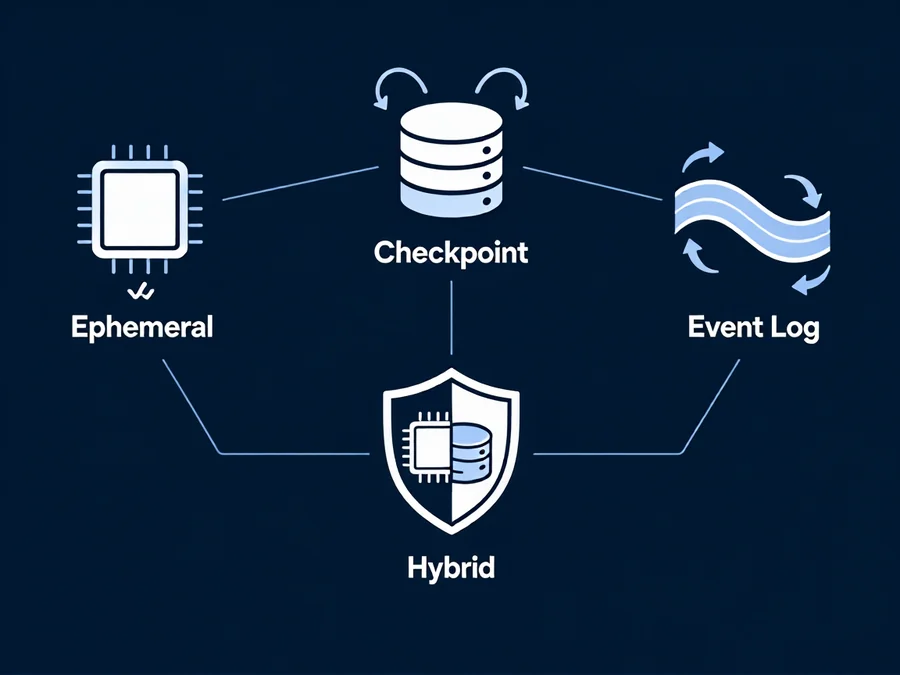
Agent state encompasses everything the system needs to remember between interactions to continue work coherently. This is broader than conversation history. It includes execution context, tool results, decision rationale, intermediate computation, confidence scores, and the structural plan that guides multi-step workflows.
Understanding the full scope prevents under-engineering. Teams often persist only conversation logs and discover too late that the agent cannot recover because execution metadata was never saved. A complete state inventory looks like this:
| State Category | Examples | Persistence Priority |
|---|---|---|
| Conversation history | User messages, assistant responses, tool calls and results | High |
| Execution context | Current task, active sub-goals, branching decisions | Critical |
| Tool state | Open file handles, API pagination cursors, partial writes | Medium |
| Memory artifacts | Retrieved documents, computed embeddings, cached results | Low |
| Confidence metrics | Per-decision scores, uncertainty estimates, fallback triggers | High |
| External side effects | Records created, emails sent, databases updated | Critical |
Each category has different recovery requirements. Conversation history is easy to restore from logs. Execution context requires explicit checkpointing. Side effects require idempotency tracking to avoid duplicate work during recovery.
When Session Failures Happen
Session failures are not edge cases. They occur regularly in production through predictable channels: network timeouts during LLM API calls, platform scaling events that drain containers mid-execution, intentional restarts for maintenance, user cancellations, and resource exhaustion from token limits or memory pressure.
The common thread: any failure that interrupts execution between checkpoints destroys unpersisted state. The solution is systematic checkpointing at the right granularity.
Core State Management Patterns
Production AI agents use one of four established patterns for state persistence.
Pattern 1: Ephemeral In-Memory State
The simplest approach stores all state in process memory. The agent runs, completes its task, and returns. If the process dies, state is lost. This works for short-lived fire-and-forget tasks where failure is acceptable — status checks, simple transformations, one-shot queries. Do not use this for agents that perform side effects, run longer than five minutes, or operate in environments with unreliable networking.
Pattern 2: Checkpoint-Based Persistence
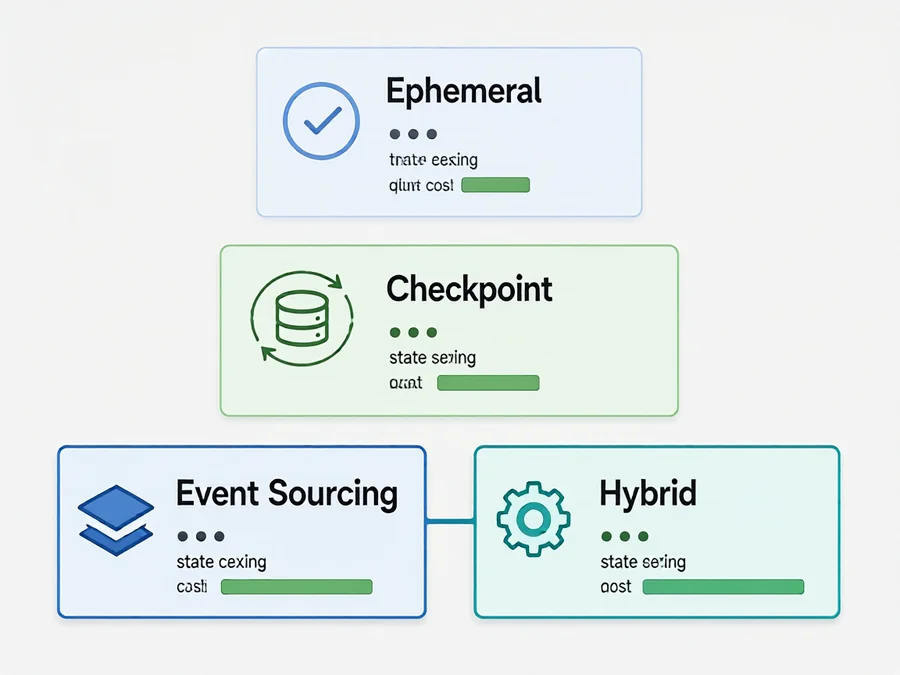
Checkpoint persistence saves the agent’s complete state at defined intervals. A checkpoint captures conversation history, execution context, tool results, and the current decision point. On recovery, the agent restores from the most recent checkpoint and continues from where it left off.
Checkpoints use structured serialization stored in Redis, PostgreSQL, or object storage. The key design decision is checkpoint frequency. Too frequent means high write costs. Too infrequent risks losing significant work. A practical rule: checkpoint after each completed tool call for short tasks, and at logical milestones for long-running workflows.
Pattern 3: Event Sourcing
Event sourcing persists every action as an immutable event. The agent’s current state is derived by replaying events from the beginning. Recovery means replaying the event stream to reconstruct the exact state at any point. This provides complete auditability and enables time-travel debugging. The cost is higher complexity: event replay can be slow for long sessions, storage grows linearly, and schema versioning becomes essential.
Pattern 4: Hybrid Checkpoint-Event Architecture
The most robust production systems combine both approaches. Periodic snapshots provide fast recovery points. The event log between snapshots captures fine-grained actions for audit and debugging. Recovery restores from the nearest snapshot, then replays events from that point forward. Most enterprise AI agent platforms, including SmaugBrain, implement variations of this pattern.
Implementation Guide
Step 1: Define Your State Schema
Document what state your agent needs to preserve. For each category, decide: is this state recoverable? How expensive is recomputation? What is the consequence of losing it? State that is expensive to recompute and costly to lose should be prioritized for persistence.
Step 2: Choose Your Storage Backend
Redis is the standard for high-throughput agent platforms. Sub-millisecond read/write latency, built-in TTL for automatic cleanup, and atomic operations make it ideal for fast checkpoint writes during active execution.
PostgreSQL provides strong consistency and transactional guarantees. Use it when state integrity is critical — for example, when agent actions trigger financial transactions. It also excels at complex queries across agent histories for audit and analytics.
Object storage (S3, GCS) handles arbitrarily large state payloads with eventual consistency, suitable for periodic backups and archival.
Many systems use a combination: Redis for hot checkpoints, with replication to PostgreSQL or object storage for durability.
Step 3: Implement the Checkpoint Writer
Use atomic writes to ensure checkpoints are either fully written or not present. Include a schema version in every checkpoint for backward compatibility. Compress checkpoints using gzip or zstd — a 5MB raw checkpoint might compress to 500KB. Set automatic expiration with TTL policies of 24–72 hours for abandoned sessions.
Step 4: Implement the Recovery Path
Recovery must locate the most recent valid checkpoint, deserialize and validate it, reconstruct the agent’s internal representation, and resume from the last action. Critical behaviors include idempotency verification — checking that side effects from the last action actually occurred before resuming — conflict resolution when multiple checkpoints exist, and graceful degradation when no valid checkpoint is found.
Failure Modes and Prevention
Stale checkpoint corruption. A checkpoint saved during partial execution may contain inconsistent state. Validate every checkpoint field has a corresponding sibling before accepting it.
Checkpoint storm. Under high concurrency, simultaneous checkpoints overwhelm storage. Throttle frequency during peak load or batch multiple checkpoints into a single write.
Schema drift. Maintain backward-compatible deserialization with defaults for missing fields and upgrade routines for removed ones.
Double execution on recovery. The most dangerous failure: the agent resumes and performs actions already completed before the failure. Prevent this with idempotency keys attached to every side-effect-producing action.
Evaluating State Management Maturity
| Requirement | Recommended Pattern | Complexity |
|---|---|---|
| Single-session, under 2 minutes, no side effects | Ephemeral in-memory | Minimal |
| Multi-turn conversations, recoverable on refresh | Checkpoint to Redis | Low |
| Long workflows, idempotent side effects | Checkpoint plus idempotency keys | Medium |
| Audit-required, regulatory compliance | Event sourcing | High |
| Collaborative multi-agent, shared state | Event sourcing plus consensus | Very high |
| Production SaaS with SLA guarantees | Hybrid checkpoint-event | High |
Most production deployments fall into the checkpoint-with-idempotency category. Platforms like SmaugBrain implement this pattern out of the box, allowing teams to focus on agent logic rather than infrastructure.
Conclusion
State management is the invisible foundation of reliable AI agents. It determines whether your agent recovers from failures with grace or collapses into redundant loops. Every production agent will experience session failures. The question is not whether to persist state, but how deeply. Start with checkpoint-based persistence and idempotency keys. Evolve toward event sourcing only when audit requirements demand it.
Agents that survive failure are agents that users trust. Build state management into your architecture from day one.
Frequently Asked Questions
Q: How often should I checkpoint?
A: After every completed tool call for short workflows under ten minutes. For longer workflows, checkpoint at logical milestones — task boundaries, major decisions, and before expensive computations. If losing the last thirty seconds would frustrate the user, checkpoint more frequently.
Q: Can I use the same schema for development and production?
A: Yes. Different schemas create subtle bugs that appear only in production. Use feature flags for experimental state fields while maintaining production compatibility.
Q: How do I handle checkpoint size limits?
A: Implement sliding-window truncation that preserves recent exchanges while summarizing older ones. Keep full history in a separate append-only store. Target checkpoint sizes under 1MB.
Q: What happens when storage is unavailable during checkpointing?
A: Buffer checkpoints in local memory and flush when available. If the buffer fills, downgrade to saving conversation summaries instead of full state. Never let storage unavailability block execution entirely.
Q: How does state management relate to agent memory?
A: State management handles short-term operational context and failure recovery. Memory systems handle long-term knowledge across sessions. Both are necessary for production agents.
Q: Can SmaugBrain handle state persistence automatically?
A: Yes. SmaugBrain provides built-in checkpoint persistence, automatic recovery from session failures, idempotency tracking, and configurable TTL policies. Agents recover seamlessly across scaling events and interruptions without manual state management code. Explore SmaugBrain to see how automated state management simplifies production deployment.
Q: Should I use event sourcing for every agent application?
A: No. Use it when you need complete audit trails, regulatory compliance, time-travel debugging, or collaborative multi-agent systems. For most single-agent deployments, checkpoint-based persistence with idempotency keys is sufficient.