
AI Agent Architecture Patterns: Reactive, Planning, and Hierarchical Systems
Introduction
When building AI agents for production, one of the most critical decisions is choosing the right architecture pattern. The pattern you select determines how your agent handles complexity, scales, and recovers from failures. This guide covers the three main AI agent architecture patterns — reactive, planning, and hierarchical — and provides a decision framework to help you choose the right one for your use case.
Most organizations start with a reactive pattern and graduate to more sophisticated architectures as their requirements grow. Understanding the trade-offs upfront saves significant rework later and ensures your agent system can evolve alongside your business needs.
What Are AI Agent Architecture Patterns?
AI agent architecture patterns define how an agent processes inputs, makes decisions, and executes actions. Each pattern has different capabilities around:
The three primary patterns — reactive, planning, and hierarchical — form a spectrum from simple to complex. Most production systems use a hybrid approach, combining elements from multiple patterns to optimize for both performance and capability.
Pattern 1: Reactive Architecture
How It Works
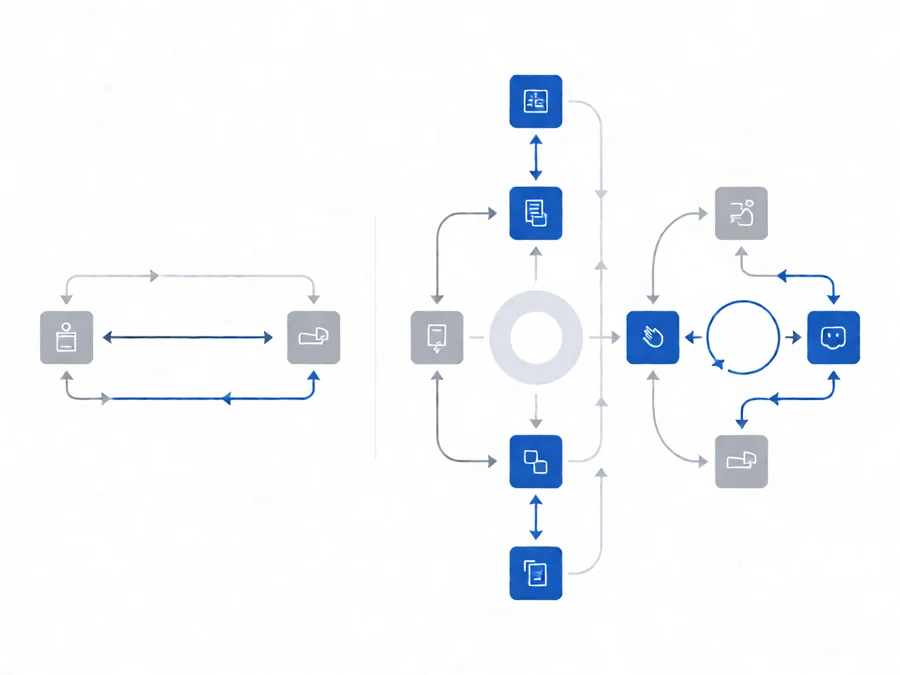
A reactive agent follows a simple loop: observe input → decide action → execute → repeat. There is no long-term planning or memory of past interactions beyond the current session context. Each interaction is treated independently.
“`
Input → [Reasoning] → Action → Output
↓
Next Input
“`
Best For
Advantages
Limitations
Real-World Example
A customer support chatbot that answers FAQs using a single tool call per response is a classic reactive agent. It reads the user question, queries the knowledge base, and returns an answer — all in one pass. If the question requires multiple data sources or sequential reasoning, the reactive agent will struggle.
Pattern 2: Planning Architecture
How It Works
A planning agent breaks complex tasks into sequences of steps, executes each step, and adjusts its plan based on intermediate results. The agent maintains a goal state and works toward it through iterative reasoning. Planning agents can handle uncertainty by revising their approach when initial assumptions prove incorrect.
“`
Goal → [Plan Generator] → Step 1 → Execute → Result
↓
Step 2 → Execute → Result
↓
Step 3 → Execute → Goal Reached
“`
Best For
Advantages
Limitations
Real-World Example
An AI research assistant that gathers information from multiple sources, synthesizes findings across documents, and generates a comprehensive report is a planning agent. It plans the research steps, executes them sequentially, refines its approach based on what it discovers, and produces a final deliverable.
Pattern 3: Hierarchical Architecture
How It Works
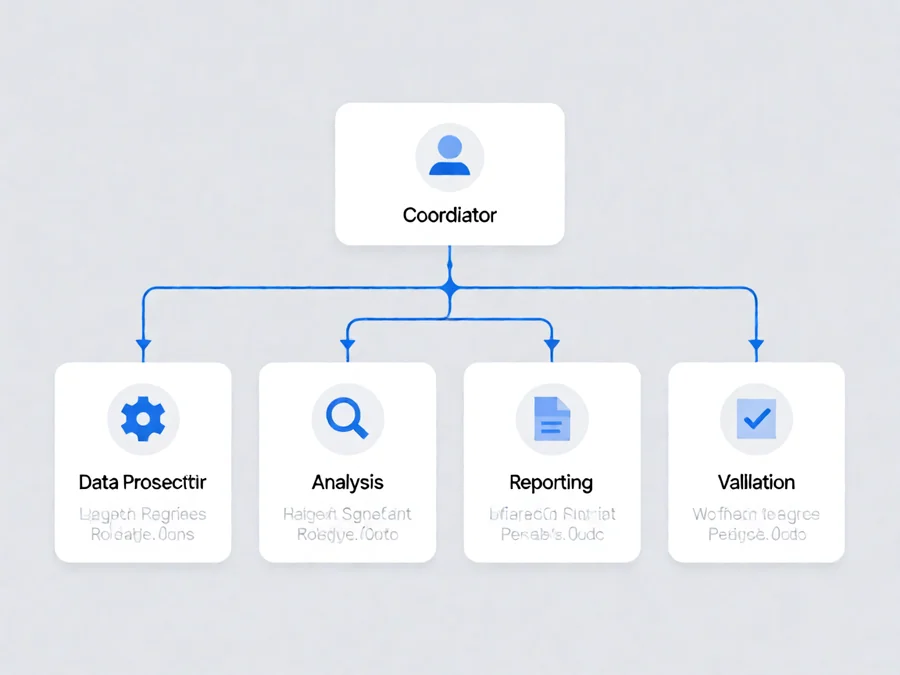
A hierarchical agent delegates sub-tasks to specialized sub-agents, each handling a specific domain or function. A coordinator agent manages the overall workflow, delegates tasks appropriately, and aggregates results from all sub-agents into a cohesive output.
“`
Coordinator Agent
├── Sub-Agent A: Data Processing
├── Sub-Agent B: Analysis
├── Sub-Agent C: Reporting
└── Sub-Agent D: Validation
“`
Best For
Advantages
Limitations
Real-World Example
An enterprise automation platform that coordinates marketing, sales, and support agents to handle a complex customer journey is hierarchical. Each department has specialized agents that communicate through a central coordinator, allowing parallel processing of independent tasks while maintaining overall workflow coherence.
Decision Framework: Which Pattern Should You Choose?
Use this comprehensive checklist to evaluate your requirements and select the appropriate architecture:
| Requirement | Reactive | Planning | Hierarchical |
|————-|———-|———-|————–|
| Task complexity | Low (1-2 steps) | Medium (3-10 steps) | High (10+ steps, parallel) |
| Latency requirement | <1 second | 1-10 seconds | 10+ seconds acceptable |
| Tool count | 1-3 tools | 3-10 tools | 10+ tools |
| Parallel execution needed | No | Optional | Yes |
| Error tolerance | High (simple fallback) | Medium (retry logic) | Low (needs coordination) |
| Team size | 1-2 developers | 2-5 developers | 5+ developers |
| Budget constraint | Low | Medium | High |
| Frequency of use | Daily, high volume | Weekly, moderate volume | Monthly, complex projects |
| Failure impact | Low (can retry) | Medium (partial failure) | High (systemic impact) |
Implementation Considerations
For Reactive Agents
Start with simple prompt templates and single tool calls. Validate responses thoroughly before adding complexity. Use strict output schemas to maintain predictability. Implement circuit breakers for external service dependencies.
For Planning Agents
Implement step-level validation and rollback mechanisms. Track execution state persistently to enable recovery from arbitrary failure points. Monitor token usage closely to control costs. Add human approval checkpoints for high-stakes operations.
For Hierarchical Agents
Define clear interfaces and communication protocols between sub-agents. Implement circuit breakers for dependent services to prevent cascading failures. Use asynchronous communication where possible to maximize parallelism. Monitor inter-agent message queues for bottlenecks.
Common Mistakes to Avoid
1. Over-engineering simple tasks
Don’t use a hierarchical pattern for a FAQ bot. Start simple and scale up only when requirements demand it. Over-engineering introduces unnecessary complexity and cost.
2. Ignoring context limits
Planning and hierarchical agents consume significantly more context. Monitor token usage carefully and implement chunking strategies to stay within model limits.
3. Under-testing failure modes
Complex patterns have exponentially more failure points. Test edge cases thoroughly before production deployment, including network failures, API timeouts, and malformed responses.
4. Skipping human oversight
Even advanced agents need human review for critical decisions. Implement approval workflows for high-stakes actions and maintain audit trails for compliance.
5. Not planning for scale
Design with scaling in mind from the beginning. What works for 10 users may fail catastrophically at 10,000. Plan your architecture accordingly.
Hybrid Approaches
Most production systems use hybrid patterns that combine the strengths of multiple approaches:
Hybrid approaches allow you to optimize for both performance and capability, using the right pattern for each component of your system.
Case Studies
Case Study 1: E-commerce Support Automation
A mid-size e-commerce company implemented a hybrid architecture. Simple product questions used reactive agents for instant responses. Complex order issues triggered planning agents that could check inventory, process refunds, and coordinate with shipping. Rare escalations used hierarchical patterns with specialized fraud detection and customer success sub-agents.
Case Study 2: Financial Document Analysis
A fintech startup built a planning agent for document analysis. The agent broke down the task into extraction, validation, classification, and reporting steps. Each step could be retried independently, and the agent adjusted its approach based on data quality encountered during extraction.
Case Study 3: Enterprise Workflow Automation
A large corporation deployed a hierarchical system with department-specific sub-agents. Marketing, sales, operations, and compliance each had specialized agents coordinated by a central workflow manager. The system processed thousands of transactions daily with 99.9% uptime.
Measuring Success
Track these metrics to evaluate your agent architecture:
Conclusion
Choosing the right AI agent architecture pattern depends on your task complexity, latency requirements, team capabilities, and budget constraints. Start with the simplest pattern that meets your needs, and graduate to more sophisticated architectures as requirements grow and you gain experience.
For production deployments, consider starting with a planning pattern as it offers the best balance of capability and complexity for most use cases. Only move to hierarchical architectures when you have clear parallelization needs and the team maturity to manage the increased complexity.
Remember: the best architecture is the one that solves your problem reliably and scales appropriately. Don’t choose complexity for its own sake — choose capability that matches your actual requirements.
Frequently Asked Questions
Q1: Can I switch from one architecture pattern to another?
Yes, but plan for refactoring. Most systems start reactive and evolve. Build modular components with clear interfaces to make future transitions smoother. Document your architecture decisions and rationale.
Q2: How do I handle failures in a planning agent?
Implement step-level validation, retry logic with exponential backoff, and fallback mechanisms. Track execution state persistently to enable recovery from arbitrary failure points. Log all failures for post-mortem analysis.
Q3: What’s the token cost difference between patterns?
Reactive agents typically use 500-2000 tokens per interaction. Planning agents use 2000-10000 tokens depending on chain length. Hierarchical agents can exceed 10000 tokens with coordination overhead. Budget accordingly.
Q4: Should I use the same pattern for all my agents?
No. Different tasks have different requirements. Use reactive for simple lookups, planning for multi-step workflows, and hierarchical for complex projects requiring parallelization. Match the pattern to the problem.
Q5: How do I monitor agent performance effectively?
Track latency, success rate, token usage, and user satisfaction. For hierarchical agents, also monitor inter-agent communication patterns, queue depths, and coordination overhead. Set up alerts for anomalous behavior.
Q6: What’s the minimum team size for each pattern?
Reactive: 1-2 developers with basic prompt engineering skills. Planning: 2-5 developers with API integration experience. Hierarchical: 5+ developers with system design expertise and DevOps capabilities.
Q7: Can AI agents use multiple patterns simultaneously?
Yes, hybrid approaches are common and recommended. A coordinator might use planning to decompose tasks while sub-agents use reactive patterns for execution. Define clear boundaries between patterns.
Q8: How do I ensure security across all patterns?
Implement consistent authentication, authorization, and audit logging across all patterns. Use least-privilege principles for tool access. Validate all inputs and outputs. Monitor for anomalous behavior patterns.
*Ready to implement AI agent patterns in your organization? Explore [SmaugBrain](https://www.smaugbrain.com/) for production-ready agent orchestration tools and architecture guidance.*