
AI Agent Context Window Management: Handling Long Conversations and Large Documents
Every AI agent eventually hits the same wall: the context window. Whether you’re processing a 200-page technical manual, maintaining a week-long conversation thread, or chunking through thousands of documents for retrieval, context management is the difference between an agent that works reliably and one that degrades gracefully—or doesn’t at all.
This guide covers practical strategies for managing context in production AI agents, from chunking techniques and summarization pipelines to cost optimization and error handling. You’ll learn how to design systems that stay within token limits while maintaining accuracy and performance.
Understanding Context Windows
What Is a Context Window?
A context window is the maximum number of tokens an LLM can process in a single request. Tokens include words, punctuation, and special characters. Most production models support between 4,000 and 128,000 tokens, with the sweet spot for cost-performance typically between 8,000 and 32,000 tokens.
Understanding token count is essential because it directly impacts both latency and cost. Longer prompts take more time to process and consume more API credits per request. For agents running hundreds or thousands of requests daily, context optimization becomes a significant cost factor.
Why Context Matters for Agents
AI agents rely on context for three critical functions:
- Tool descriptions and system prompts — Every tool definition, memory state, and instruction competes for tokens
- Conversation history — Multi-turn interactions accumulate tokens rapidly, often doubling every few exchanges
- Retrieved documents — RAG systems fetch relevant chunks, but each chunk consumes context proportional to document size
When these elements exceed the context window, agents either fail with errors or produce degraded output by truncating critical information. The consequences range from missing important instructions to returning incorrect responses based on incomplete context.
Chunking Strategies
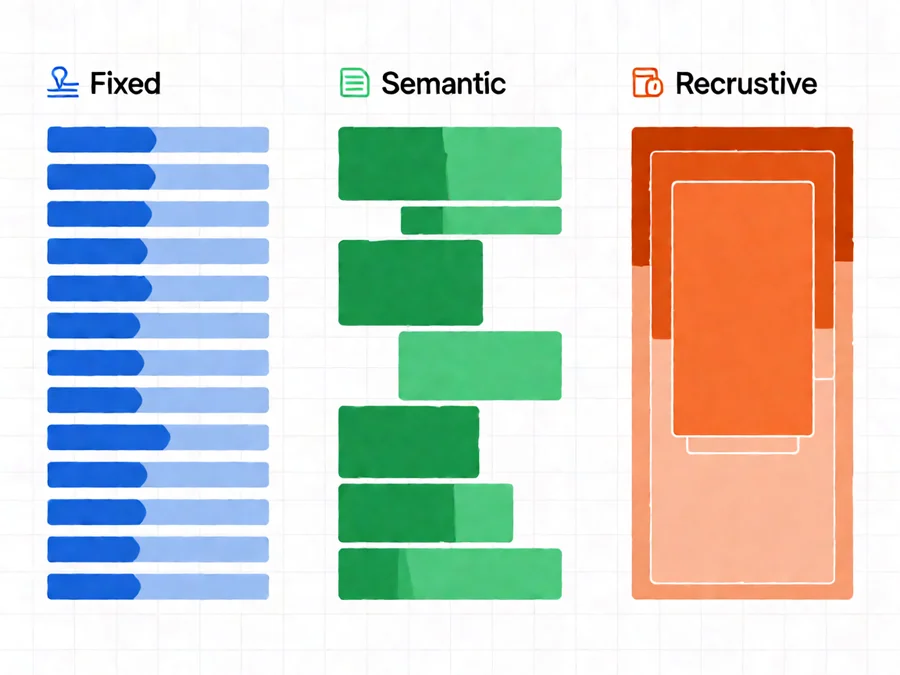
The way you divide documents into chunks fundamentally affects retrieval quality and token efficiency. Poor chunking leads to fragmented context where related information is scattered across multiple chunks, forcing the agent to make multiple API calls or work with incomplete information.
Fixed-Size Chunking
The simplest approach divides documents into equal-sized pieces. While easy to implement, fixed-size chunking often splits sentences, breaks semantic boundaries, and creates redundant overlap.
Semantic Chunking
Semantic chunking respects natural document structure—paragraphs, sections, and topics. This approach preserves meaning across chunks and reduces the need for excessive overlap.
Recursive Character Chunking
LangChain’s recursive character chunking splits on common separators (newlines, spaces, characters) until chunks fit within size limits. It’s a practical middle ground between fixed-size and semantic approaches, handling edge cases where paragraphs vary dramatically in length.
Choosing the Right Chunking Strategy
The optimal chunking strategy depends on your document type and retrieval needs. For legal documents with strict section hierarchies, semantic chunking preserves important boundaries. For code documentation with mixed prose and code blocks, recursive chunking handles irregular structure better. Always test retrieval quality across different chunk sizes before committing to a production strategy.
Summarization Pipelines
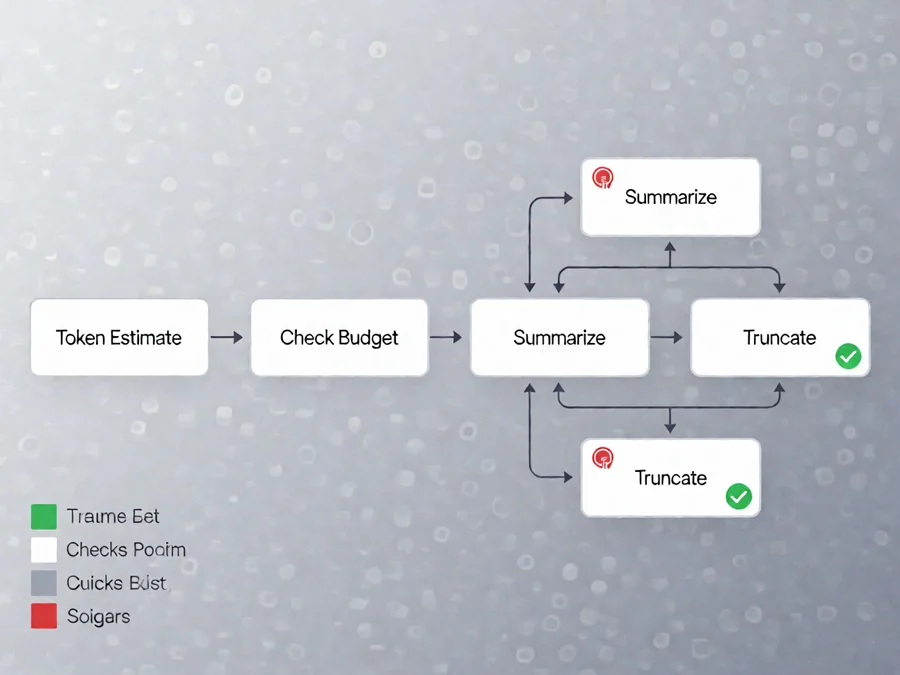
When documents exceed chunking feasibility, summarization becomes essential. The key is strategic summarization rather than blind compression, which can lose critical details needed for accurate responses.
Map-Reduce Summarization
Process documents in parallel, then summarize the summaries:
- Map phase: Split documents into chunks, summarize each independently
- Reduce phase: Combine all summaries into a final condensed version
This approach handles large document sets efficiently and allows parallelization across multiple API calls.
Progressive Summarization
For conversation history, use progressive summarization to maintain the most recent context while compressing older exchanges:
- Keep the last N turns in full detail
- Summarize earlier turns into brief action items
- Replace full history with the summary plus recent context
Sliding Window with Summaries
Combine summarization with a sliding window approach. Each turn, summarize the oldest segment before adding new context:
- Detect approaching token limits
- Trigger summarization of oldest conversation segment
- Replace raw text with summary
- Add new turn to the window
Cost Optimization Techniques
Token Budgeting
Set explicit token budgets for different agent components:
- System prompt: 500-1,000 tokens
- Tool definitions: 1,000-2,000 tokens
- Conversation history: 2,000-8,000 tokens
- Retrieved documents: 4,000-16,000 tokens
Monitor usage at each component and adjust dynamically based on task complexity and available budget.
Early Stopping and Truncation
Implement graceful degradation when tokens approach limits by checking token count before each API call, dropping oldest conversation turns if near limit, and truncating retrieved documents if still over limit. Never allow the call to fail unexpectedly.
Model Tiering
Use smaller models for simple tasks and reserve large models for complex reasoning: Fast cheap model for tool selection simple Q&A and formatting; powerful model for complex reasoning code generation and multi-step planning. Route requests based on task complexity to reduce costs by 60-80% while maintaining quality where it matters most.
Common Pitfalls
Pitfall 1: Treating All Context Equally
Not all tokens are created equal. System instructions and recent messages carry more weight than old conversation history. Always prioritize keeping critical instructions and recent context over archival conversation.
Pitfall 2: Over-Chunking Documents
Smaller chunks seem safer, but they increase API calls and fragmentation. Start with chunk sizes that preserve semantic meaning (400-800 tokens) rather than minimizing size at all costs.
Pitfall 3: Ignoring Token Estimates
Token counting isn’t exact, but rough estimates prevent surprises. Use libraries like tiktoken for accurate counting, and always include buffer room (10-20%) in your budgets.
Pitfall 4: No Fallback for Limit Exceeded
Your agent should never crash when hitting context limits. Implement automatic summarization, truncation, or model switching as recovery mechanisms.
Pitfall 5: Hardcoding Context Sizes
Different tasks need different context budgets. A coding agent needs more space for code snippets than a customer support agent. Design your system to adapt context allocation based on task type.
Implementation Guide
Building a Context Manager
A production-ready context manager implements token estimation, budget checking, and automatic trimming when limits are approached. Key components include: token counter using tiktoken for accurate estimation; dynamic budget allocation based on component priority; automatic summarization trigger when 70% budget is consumed; graceful degradation path for limit exceeded scenarios.
Monitoring and Alerting
Implement continuous monitoring to catch context issues early. Track tokens used per request, trigger alerts at 70% and 90% of your model’s limit, and log summarization events for analysis.
Testing Your Context Strategy
Before deploying, test with realistic scenarios including stress testing with increasingly long documents, edge cases with empty history or very long single messages, recovery validation to verify summarization preserves critical information, and performance benchmarking to measure latency impact of summarization.
Real-World Implementation
E-commerce Support Agent
An agent handling customer support tickets processes thousands of product documents using semantic chunking by product category, daily summarization of ticket threads, a 24,000 token budget per request out of 32,000 limit, and auto-summarization when 80% budget is consumed. Result: 99.2% success rate with 40% cost reduction versus naive implementation.
Code Review Agent
An agent reviewing pull requests handles large codebases with file-based chunking at 500 tokens, map-reduce summarization for PR-wide summaries, prioritized token budget favoring changed files over full repo, and recovery by skipping low-priority files when near limit. Result: maintains accuracy while processing repositories 10x larger than naive approaches.
Implementation Checklist
- Token counting implemented with tiktoken or equivalent
- Token budget defined for each component
- Automatic summarization triggered at 70% budget threshold
- Fallback recovery for limit exceeded errors
- Model tiering configured for cost optimization
- Monitoring and alerting for token usage patterns
- Regular review of context efficiency metrics
- Stress testing with realistic document volumes
- Human validation of summarization quality
FAQ
How do I know when my agent is approaching context limits?
Monitor token usage per request. Most providers return usage metadata. Set alerts at 70% and 90% of your model’s limit.
What’s the best chunk size for RAG systems?
Start with 400-800 tokens with 10-20% overlap. Adjust based on your document structure and retrieval accuracy.
Can I increase my context window for free?
Some providers offer larger contexts for paid tiers. Always check your provider’s pricing before architecting around context size.
How often should I summarize conversation history?
Summarize when you reach 60-70% of your token budget, or every 10-15 turns for active conversations.
What happens if summarization loses critical information?
Implement a hybrid approach: keep key messages in original form while summarizing routine exchanges. Test with human reviewers to validate information retention.
Conclusion
Context window management isn’t a one-time setup—it’s an ongoing optimization process. Start with semantic chunking and progressive summarization, monitor your token usage, and iterate based on real-world performance. The agents that handle context well are the ones that scale reliably in production.
Remember: the goal isn’t to maximize context usage—it’s to use context intelligently. A well-managed agent with 8,000 tokens will outperform a poorly managed one with 128,000.
Ready to build production-ready AI agents? Learn how SmaugBrain helps teams deploy reliable agent systems at scale. Visit https://www.smaugbrain.com/ to explore our platform.