
AI Agent Evaluation and Testing: A Production Guide
Shipping an AI agent to production is fundamentally different from deploying traditional software. Traditional applications follow deterministic logic—given the same input, they produce the same output. AI agents powered by large language models introduce non-determinism at every layer: reasoning, tool selection, parameter generation, and multi-step orchestration. A single prompt change can silently degrade performance across dozens of test scenarios.
This guide covers the evaluation strategies, testing frameworks, and production monitoring practices that separate reliable AI agents from fragile prototypes. Whether you are building a customer service agent, a code-assistance tool, or an autonomous workflow system, the principles below will help you ship with confidence and maintain quality over time.
Why Agent Evaluation Is Fundamentally Different from Traditional Testing
Traditional software testing validates deterministic behavior. You write unit tests that assert exact outputs for known inputs. A test either passes or fails based on a binary comparison. AI agents operate in a probability space, not a boolean one. The same prompt can produce different outputs across runs, and correctness often depends on context, intent, and business alignment rather than exact string matching.
The Three Layers of Agent Failure
Agent failures rarely originate from a single source. They typically cascade through three distinct layers, each requiring different detection strategies.
| Failure Layer | What Goes Wrong | Detection Difficulty |
|---|---|---|
| Reasoning layer | Incorrect chain-of-thought, missed constraints, logical gaps in planning | High — requires trajectory analysis, not just output checking |
| Tool use layer | Wrong tool selected, incorrect parameters, missing error handling | Medium — observable in tool call logs but easy to miss in pass/fail tests |
| Orchestration layer | Poor multi-step coordination, redundant loops, failure to escalate | Very high — only visible in end-to-end scenarios with realistic inputs |
A 2025 arXiv study on multi-agent failures found that 17.14% of agent failures stem from step repetition loops, and 13.98% result from mismatches between reasoning and action. These failure modes are invisible to traditional unit tests because they only examine final outputs, not the path taken to reach them.
Evaluation Metrics That Actually Matter in Production
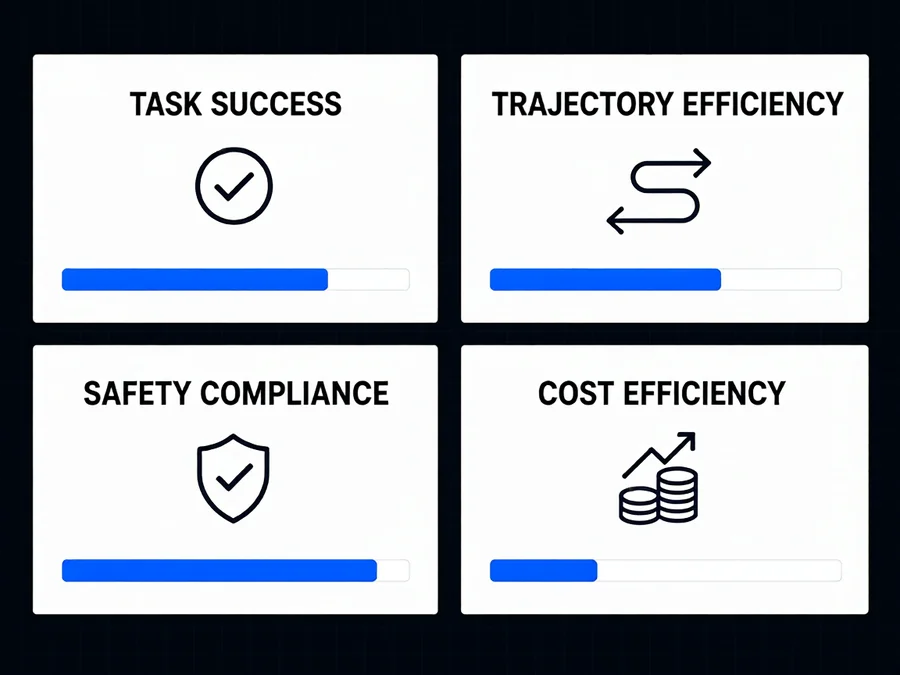
Setting the right metrics is the first step toward reliable agent deployment. The most effective production teams measure across four dimensions: task success, trajectory efficiency, safety compliance, and cost efficiency.
Task Success Metrics
Task success is the most fundamental metric, but it requires careful definition. Success means different things depending on the agent type:
- Customer service agents: Task resolution rate, first-contact resolution, escalation accuracy
- Coding agents: Test pass rate, PR acceptance rate, bug introduction rate
- Data processing agents: Data quality score, schema compliance, pipeline completion rate
- Research agents: Source relevance score, citation accuracy, synthesis completeness
Trajectory Efficiency Metrics
How efficiently an agent reaches its goal matters as much as whether it reaches the goal. Key trajectory metrics include:
- Steps to completion: Number of agent turns required. Excessive steps indicate poor planning or missing tools.
- Tool call count per task: Redundant or unnecessary tool calls increase cost and latency.
- Time to completion: End-to-end latency from user request to task finish, measured at p50, p95, and p99 percentiles.
- Trajectory length distribution: Mean steps alone hide long-tail efficiency problems. Report the full distribution to understand worst-case behavior.
Safety and Compliance Metrics
Agents that operate in production must adhere to safety boundaries. Track these metrics proactively:
- Policy violation rate: How often the agent attempts actions outside its authorized scope
- False positive escalation rate: Agent escalates to human when it could have handled the task
- False negative escalation rate: Agent proceeds without escalation when human review was required
- Input sanitization coverage: Percentage of user inputs that pass through validation before reaching the model
Pre-Deployment Testing Strategies
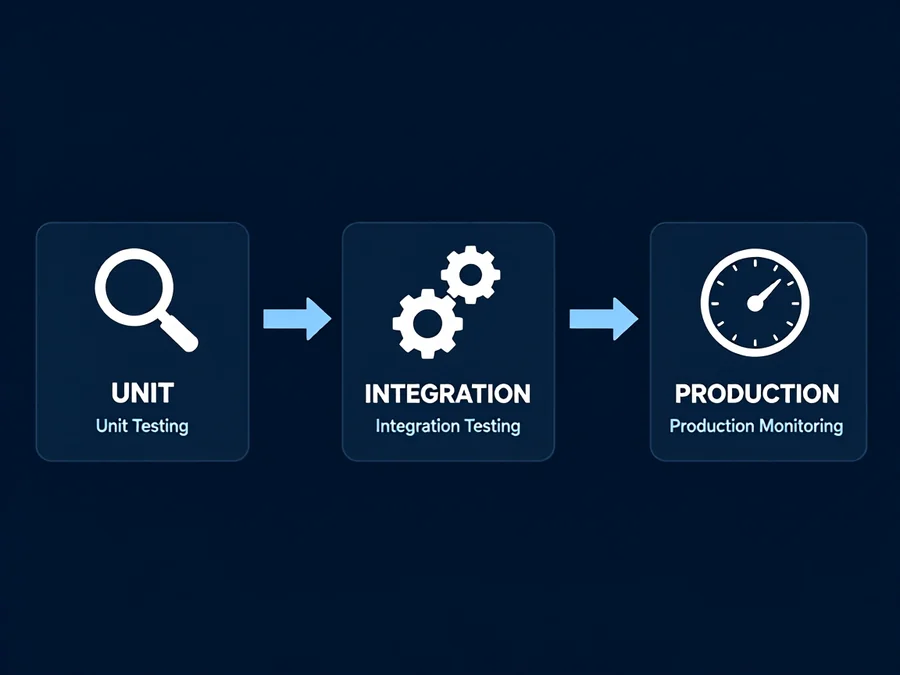
Before an agent reaches production, it should pass through a tiered testing pipeline. Each tier addresses different failure modes and requires different tooling.
Unit-Level Prompt Testing
At the unit level, test individual prompts and sub-agents in isolation. Use golden datasets—carefully curated collections of input-output pairs that represent expected behavior. Tools like Promptfoo, Braintrust, and LangSmith support this pattern by allowing you to define test cases and run them across prompt variations.
Effective golden datasets share these characteristics:
- Diversity: Cover edge cases, ambiguous inputs, and common failure patterns—not just happy paths
- Stability: Test cases should not require frequent revision as the underlying model updates
- Graded scoring: Use rubric-based evaluation on a 0-to-5 scale rather than binary pass/fail for subjective qualities like tone, relevance, and completeness
- Version control: Store test cases alongside your agent code so changes are traceable
Scenario-Based Integration Testing
Integration testing validates that agent components work together correctly. Build scenario-based test suites that simulate realistic user workflows end-to-end. Each scenario should include a user persona, a task description, available tools, expected success criteria, and explicit failure conditions the agent must handle gracefully. Run each scenario multiple times to account for model non-determinism—single-run tests produce misleading results.
sandboxed Environment Testing
For agents that interact with external systems, always test in a sandboxed environment before production deployment. Sandboxing prevents accidental data modification, API abuse, or security boundary violations during testing.
| Sandbox Requirement | Purpose | Implementation |
|---|---|---|
| Data isolation | Prevent test data from contaminating production | Use sanitized or synthetic data mirrors of production schemas |
| API mocking | Control external responses during testing | Intercept API calls and return predefined responses |
| Write protection | Prevent destructive operations during tests | Block DELETE, UPDATE, and send operations; log for audit |
| Resource limits | Catch throttling and timeout issues early | Match rate limits and timeout configurations to production settings |
LLM-as-Judge Evaluation: When It Works and When It Does Not
As test suites grow from dozens to thousands of cases, manual evaluation becomes impractical. LLM-as-judge approaches use a separate language model to score agent outputs against evaluation rubrics. This approach scales well but introduces its own failure modes that every production team should understand.
When LLM-as-Judge Works Well
LLM judges are most effective for evaluating qualitative dimensions where human judgment would also be subjective:
- Tone and style consistency: Does the agent maintain appropriate professionalism across interactions?
- Completeness: Does the response address all parts of the user request?
- Reasonableness: Is the agent reasoning sound even when the conclusion is imperfect?
- Safety compliance: Does the agent avoid prohibited content or unauthorized actions?
When LLM-as-Judge Fails
LLM judges are unreliable for tasks requiring domain-specific factual verification. An LLM judge may incorrectly validate a hallucinated citation or accept a technically wrong answer that sounds plausible. For factual accuracy, use deterministic verification methods: schema validation, database lookups, formula checks, and external API verification.
Best Practices for LLM Judging
- Use a different model than the agent: Avoid circular evaluation where the same model judges its own output. A stronger model provides more reliable judgments.
- Provide explicit rubrics: Vague evaluation criteria produce inconsistent scores. Define clear dimensions with behavioral anchors for each score level.
- Cross-reference with deterministic checks: Never rely solely on LLM judges for critical safety or compliance evaluations.
- Report confidence intervals: Single-point scores are misleading. Report evaluation results with confidence intervals across multiple runs.
Continuous Production Monitoring and Drift Detection
Testing before deployment is necessary but insufficient. The 2026 best practice is to design your observability stack alongside your agent architecture, not after. Production drift—gradual degradation of agent performance over time—is the most common cause of post-launch quality issues.
Real-Time Metrics Dashboards
Production dashboards should track the same four dimensions used in pre-deployment testing, plus two additional operational metrics:
| Metric Category | Key Indicators | Alert Threshold |
|---|---|---|
| Task success | Resolution rate, escalation rate, user satisfaction score | Drop below 90% of baseline triggers investigation |
| Trajectory quality | Mean steps, p95 latency, tool call distribution | P95 latency exceeds 2x baseline |
| Safety compliance | Policy violation count, false escalation rate | Any increase requires immediate review |
| Cost efficiency | Token usage per task, cost per resolved ticket | Cost per task increases by more than 30% |
| System health | API error rate, model response time, queue depth | Error rate above 1% or latency above p99 threshold |
| User feedback | Thumbs down rate, follow-up question rate | Thumbs down rate exceeds 5% of interactions |
Drift Detection Methods
Drift manifests in two forms: input drift where user queries change over time, and output drift where agent responses degrade for the same inputs. Detect both with these methods:
- Statistical process control: Track key metrics using control charts. When a metric crosses 2-sigma or 3-sigma boundaries, flag it for review.
- Sampling-based quality review: Randomly sample 1 to 5 percent of production interactions daily for human review. Even small samples catch issues that aggregate metrics miss.
- Contrast set evaluation: Maintain a fixed set of 50 to 100 contrast cases spanning known failure modes. Run these cases weekly against production to detect regression.
- A/B test validation: When deploying a new agent version, run a structured A/B test with predefined success criteria across capability, cost, and safety dimensions.
Safe Rollout Strategies for Production Agents
Even with thorough pre-deployment testing, production environments reveal issues that testing cannot predict. Safe rollout strategies limit blast radius and enable rapid rollback when problems emerge.
Canary Deployments
Route a small percentage of traffic—one to five percent—to the new agent version while keeping the majority on the stable version. Monitor canary metrics closely. If task success rates, latency, and safety metrics hold, gradually increase traffic. If they degrade, roll back immediately.
Key canary metrics to watch include task completion rate compared to baseline, error rates broken down by error type, latency percentiles at p50 p95 and p99, tool call success rates, and human escalation rates.
Feature Flags for Capability Restriction
Feature flags allow you to disable specific agent capabilities without redeploying code. If a new tool integration causes unexpected behavior, you can toggle it off instantly. This is critical for agents that perform write operations—being able to restrict capabilities within seconds rather than minutes can prevent costly incidents.
Blue-Green Deployment for Stateful Agents
For agents with complex state management including session memory and persistent tools, blue-green deployment maintains two identical production environments. Deploy the new version to the inactive environment, validate it against the golden dataset, then switch traffic. If problems emerge, switch back instantly without losing state.
Common Pitfalls in Agent Evaluation
Based on production deployments across multiple verticals, these are the most frequent evaluation mistakes and how to avoid them.
Pitfall 1: Testing Only the Happy Path
Most teams build test suites around successful scenarios. But agent robustness depends on how it handles failure. Deliberately include ambiguous inputs, contradictory instructions, missing context, and adversarial prompts in your test suite. An agent that fails gracefully on bad input is more valuable than one that succeeds only on perfect input.
Pitfall 2: Evaluating Single Runs Instead of Distributions
A single test run gives a single data point. Because LLMs are non-deterministic, run each test case at least five to ten times and report the distribution of outcomes. A test that passes eight out of ten runs is fundamentally different from one that passes ten out of ten, even though both pass a binary gate.
Pitfall 3: Ignoring Trajectory Quality
An agent that solves a task in three steps is cheaper and faster than one that solves it in thirty steps, even if both produce correct outputs. Track trajectory efficiency metrics alongside correctness metrics. Agents that take excessively long trajectories often indicate missing tools, poor prompting, or inefficient orchestration patterns.
Pitfall 4: No Feedback Loop from Production
Evaluation should not stop at launch. Capture production failures, escalations, user complaints, and manual corrections, then feed them back into your test suite as new golden cases. This closed-loop improvement process is what separates mature agent operations from one-time deployments.
Pitfall 5: Overlooking Cost as a Quality Metric
An agent that achieves 99 percent task success but costs fifty dollars per interaction is not production-ready if a competitor achieves 95 percent success at two dollars per interaction. Include cost-per-task in your evaluation framework. Optimize for the Pareto frontier: maximize success rate while minimizing cost, rather than optimizing either dimension in isolation.
Building an Evaluation-First Culture
The most successful agent deployments share a common trait: evaluation is treated as a first-class engineering concern, not an afterthought. Here is how to build that culture within your team.
Embed Evaluation in CI/CD
Integrate agent evaluation into your continuous integration pipeline. Every code change, prompt update, or tool addition should trigger the full test suite before merging. Use evaluation gates that enforce minimum thresholds across task success, trajectory efficiency, and safety compliance. A change that improves success rate but doubles cost should require explicit justification.
Make Test Cases Visible
Maintain a public dashboard showing test suite coverage, pass rates, and recent failures. When the entire team can see evaluation results in real time, evaluation becomes a shared responsibility rather than a QA-only concern.
Review Failures Systematically
When a production incident occurs, conduct a structured post-mortem that answers which test case should have caught this, why the test suite did not include this scenario, and how to add it to prevent recurrence. This iterative improvement loop is what keeps evaluation effective over time.
Frequently Asked Questions
Q: How many test cases do I need for production readiness?
A: There is no universal minimum, but teams typically start with fifty to one hundred golden cases covering core workflows, then expand based on production incidents. The goal is not a specific number but comprehensive coverage of your agent operational domain. A good rule of thumb: if a production failure reveals a gap in your test suite, add at least three variants of that scenario to prevent recurrence.
Q: Should I use the same model for evaluation and production?
A: No. Use a stronger model for evaluation judgments. If your production agent runs on a cost-optimized model, evaluate it with a higher-capability model acting as judge. This prevents the evaluator from sharing the same weaknesses as the agent being evaluated. However, for deterministic checks like schema validation, API verification, and formula calculation, the evaluation model does not matter.
Q: How do I handle non-determinism in agent testing?
A: Run each test case multiple times—at least five to ten iterations—and evaluate the distribution of outcomes, not just the mode. Report success rates, confidence intervals, and variance metrics. If an agent passes nine out of ten runs on a test case, document that ninety percent pass rate rather than treating it as a simple pass or fail.
Q: What is the difference between offline and online evaluation?
A: Offline evaluation tests agent behavior against static golden datasets in a controlled environment. Online evaluation measures performance on live production traffic. Both are necessary: offline evaluation catches regressions before they reach users, while online evaluation detects drift and contextual issues that static tests cannot simulate.
Q: How often should I re-evaluate a production agent?
A: Re-evaluate after every significant change: prompt updates, tool additions, model upgrades, and orchestration modifications. Additionally, run a full evaluation suite weekly against a fixed contrast set to detect gradual drift. Teams that skip regular re-evaluation typically discover quality degradation only after user complaints or business metric impacts arrive.
Q: Can I automate the entire evaluation pipeline?
A: Most evaluation can be automated, but human review remains essential for qualitative dimensions and complex failure analysis. Automate deterministic checks, trajectory analysis, and LLM-as-judge scoring. Reserve human review for edge cases, safety-critical evaluations, and post-incident analysis. The optimal ratio shifts toward automation as your test suite matures, but never eliminates human judgment entirely.
Q: How do I measure agent ROI in production?
A: Agent ROI combines operational efficiency gains with quality improvements. Measure tasks completed per hour versus human baseline, error rate reduction, escalation rate reduction, average handling time reduction, and user satisfaction improvement. Quantify these in business terms such as time saved, cost reduced, and revenue protected to build the business case for continued agent investment.
Conclusion
Evaluating AI agents for production is not about writing better tests—it is about building a systematic evaluation practice that spans the entire agent lifecycle. From golden datasets and trajectory metrics to LLM-as-judge strategies and drift detection, every layer of evaluation reduces the risk of shipping a fragile system.
The agents that succeed in production share one trait: their teams treat evaluation as a first-class engineering discipline, not a QA checkbox. Start with a focused golden dataset, instrument the four key metric dimensions, and close the feedback loop between production failures and test coverage. The result is not just safer deployments—it is agents that improve over time rather than degrade.
Ready to Build Reliable AI Agents?
SmaugBrain provides the infrastructure for production-grade AI agent deployment with built-in observability, safe rollout controls, and evaluation integration. Learn more about SmaugBrain and start building agents that work reliably in production.