
AI Agent Hallucination Detection and Mitigation: A Production Guide
Hallucination is one of the most persistent risks in production AI agent systems. Unlike traditional software bugs, hallucinations are subtle, intermittent, and often self-concealing — the agent presents false information with the same confidence it uses for factual answers. For teams building autonomous agents that retrieve, synthesize, and act on data, understanding how to detect and mitigate hallucinations is not optional. It is a foundational production requirement.
This guide covers practical hallucination detection strategies, verification mechanisms, and architectural patterns that reduce AI agent hallucination rates in production environments.
What Is AI Agent Hallucination?
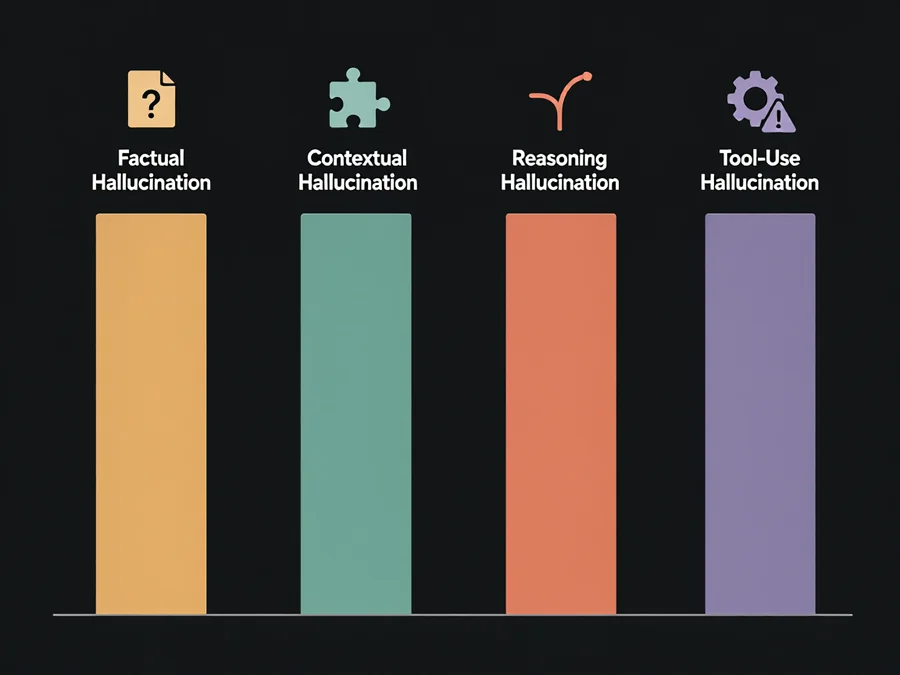
An AI agent hallucination occurs when a language model generates output that is factually incorrect, internally inconsistent, or unsupported by the provided context. Hallucinations fall into several categories:
Factual Hallucination
The model states something as true that is not supported by available sources. Example: citing a regulation that does not exist or misquoting a statute.
Contextual Hallucination
The model invents details that fit the narrative but have no basis in the input data. Example: fabricating a file path, API endpoint, or configuration value.
Reasoning Hallucination
The model produces a logically coherent but incorrect conclusion. Example: drawing a causal relationship between two unrelated events in the data.
Tool-Use Hallucination
The model describes a tool call it never made or misreports the result of an actual tool call. Example: claiming a database query returned results when it returned empty. For production AI agents, tool-use hallucination is particularly dangerous because it can trigger real system actions based on fabricated preconditions.
Why Hallucinations Are Hard to Detect
Hallucinations evade simple testing because they are probabilistic, not systematic. A model may produce correct outputs 95% of the time on a given prompt and still hallucinate on the remaining 5%. Standard unit tests that pass on a handful of examples will miss these failures entirely.
Three structural reasons make hallucination detection difficult:
- Confidence calibration gap: Modern language models assign high probability to their outputs regardless of correctness. The model does not inherently know when it is guessing.
- Context window effects: As context grows, the model can lose track of which facts came from the source data and which were inferred. Retrieval-augmented generation (RAG) systems are especially vulnerable when retrieved chunks contain contradictory or irrelevant information.
- Agent loop amplification: In multi-step agent workflows, a single hallucination early in the chain can propagate and compound. A fabricated file path leads to a failed tool call, which the model then rationalizes with another fabrication, creating a cascade that is harder to trace back to the original error.
Detection Strategies for Production Agents
Effective hallucination detection requires multiple independent verification layers. No single technique catches all hallucination types, but combined they create a robust defense.
Source Grounding Verification
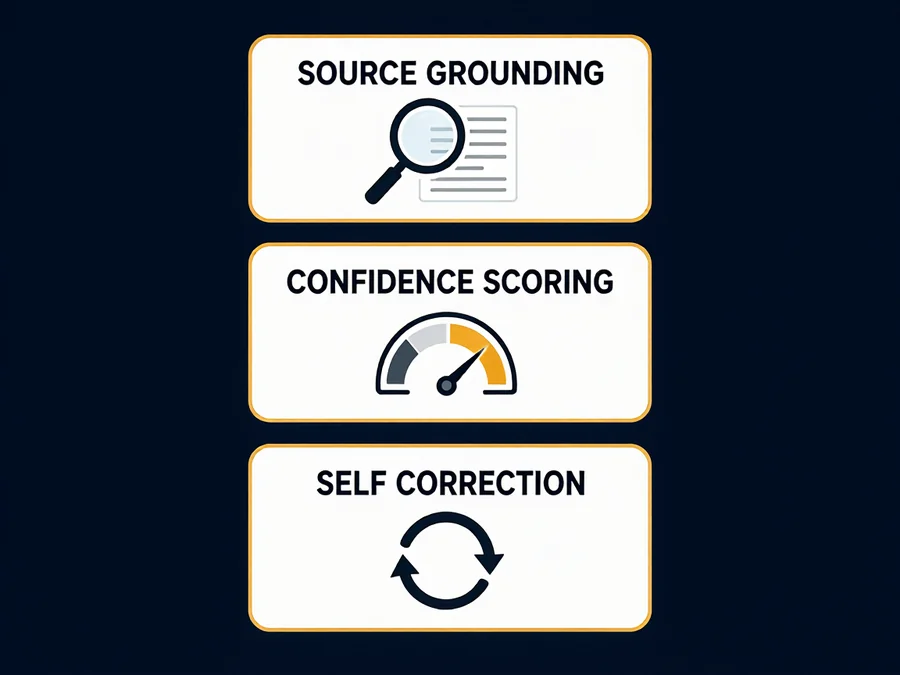
Source grounding checks whether every factual claim in the agent output can be traced to a specific piece of input context. This is the most direct detection method and should be the first layer in any production pipeline.
Implementation approach: after the agent generates a response, run a secondary verification step that extracts each factual claim and checks it against the source documents. Claims without a source match are flagged as potential hallucinations.
Practical techniques include:
- Citation enforcement: Require the agent to include inline citations for every factual statement. Parse the citations and verify they reference actual source content.
- Span extraction validation: Use a lightweight classifier or regex-based extractor to identify claims in the output, then search the source context for supporting spans. Flag any claim with no supporting span.
- Contradiction checking: Run the output through a natural language inference model to check whether each claim is entailed by, neutral to, or contradicts the source context. Claims labeled as contradiction are hallucinations.
Confidence Scoring and Thresholding
Modern LLM APIs expose confidence scores or log probabilities for generated tokens. While these scores are not perfectly calibrated, they can serve as an early warning signal when combined with other checks.
Set a minimum confidence threshold for factual claims. Claims below the threshold should trigger a re-generation or a fallback to a “I cannot verify this” response rather than presenting uncertain information as fact.
Combine confidence scoring with temperature control. Lower temperature values (0.1–0.3) reduce hallucination rates for factual tasks by narrowing the probability distribution around high-confidence tokens. Reserve higher temperature for creative or exploratory tasks where hallucination risk is acceptable.
Self-Correction Loops
Self-correction is a prompting technique where the agent reviews its own output before finalizing it. The agent is instructed to identify potential errors, verify claims against sources, and revise any statements it cannot support.
A structured self-correction prompt looks like this:
Review your response above. For each factual claim:
1. Locate the exact source text that supports it.
2. If no source text exists, mark the claim as unverified.
3. Revise the response to remove or qualify all unverified claims.
4. Return the corrected response.
Self-correction improves accuracy by 10–30% on factual tasks in published benchmarks, but it adds latency and token cost. Use it selectively for high-stakes outputs rather than on every agent turn.
Adversarial Testing
Adversarial testing deliberately constructs prompts designed to trigger hallucinations. Common adversarial patterns include:
- Obfuscation prompts: Requests with intentionally misleading context that tempts the model to correct the user rather than follow the facts.
- Counterfactual prompts: Questions about scenarios that did not happen, testing whether the model distinguishes reality from speculation.
- Boundary prompts: Requests that push the model past the edge of its knowledge, probing for confident-sounding fabrication.
Run adversarial test cases regularly — ideally as part of a CI pipeline that evaluates the agent before each deployment. Track hallucination rates across test suites to measure improvement or regression.
Architectural Patterns for Hallucination Mitigation
Detection alone is insufficient. Production systems must also be architected to limit the impact of hallucinations when they occur.
Restrictive Output Design
Design the agent output format to minimize the opportunity for hallucination. Structured outputs with strict schemas are easier to validate and harder to fabricate convincingly.
Instead of asking the agent to write a free-form summary, request a JSON object with defined fields. Each field should have a clear type constraint (string, number, boolean, enum) and an optional source reference. When the agent cannot fill a field from available sources, the schema should require a null value with a missing_reason explanation rather than a best-guess completion.
Retrieval Quality Controls
Hallucination rate correlates strongly with retrieval quality. Poorly retrieved context forces the model to fill gaps with invented information. Implement these retrieval safeguards:
- Relevance thresholding: Reject retrieved chunks whose similarity score falls below a defined threshold. Do not feed low-relevance context into the generation step.
- Chunk deduplication: Remove near-duplicate chunks before retrieval. Duplicate context increases the model’s confidence in potentially incorrect information.
- Source transparency: Always include source metadata (document name, page number, timestamp) alongside retrieved content. This enables downstream verification and post-hoc auditing.
Human-in-the-Loop Verification Gates
For high-stakes decisions — financial calculations, legal compliance checks, medical information synthesis — implement a human verification gate. The agent prepares a draft response with full source citations, and a human reviewer approves or rejects each claim before the output reaches the end user.
This does not need to be a manual review of every output. Use automated pre-screening to flag low-confidence or high-risk responses for human review while allowing routine, well-supported outputs to pass through automatically.
Fallback Responses
Define explicit fallback behavior for when the agent cannot produce a verified response. Common fallback patterns include:
- “I don’t know” response: Return a clear statement that the information is unavailable rather than generating a plausible-sounding answer.
- Source-backed partial response: Return only the claims that passed verification, omitting unverifiable sections entirely.
- Escalation to human: Route the request to a human operator with the agent’s draft and flagged uncertainty areas.
The fallback policy should be documented in the agent’s system prompt and enforced programmatically, not left to the model’s judgment.
Measuring Hallucination Rates
You cannot improve what you do not measure. Establish a hallucination metric for your agent system and track it over time.
Creating a Golden Test Set
Build a curated set of 50–200 representative prompts with known-correct answers. Include standard cases, edge cases, and adversarial cases. Have subject-matter experts or a separate verification model label each expected output.
Run the agent against this test set regularly. Score each output for hallucination rate using automated classification or manual review for a subset. Track the hallucination rate as a percentage of total outputs.
Automated Evaluation Pipeline
Implement an automated evaluation pipeline that runs on every agent code change:
- Execute the agent on the golden test set.
- Compare each output against the expected answer using semantic similarity, factual overlap scoring, and contradiction detection.
- Flag outputs where the hallucination score exceeds the acceptance threshold.
- Block deployment if the hallucination rate regresses beyond an acceptable margin.
Key Metrics to Track
Track these metrics to monitor hallucination performance over time:
| Metric | Definition | Target |
|---|---|---|
| Hallucination rate | Percentage of outputs containing at least one unverified factual claim |
Related articles |