
AI Agent Memory and Context Management: A Production Guide
Building an AI agent that works in a demo is easy. Building one that stays reliable across hours of interaction, hundreds of tool calls, and changing user intent is hard. The core challenge is context management: deciding what information the agent needs at any given moment, keeping it accessible, and preventing the context window from becoming a liability.
This guide covers the memory architectures, context engineering practices, and production patterns that separate agents that degrade over time from agents that improve.
Why Context Management Matters in Production
An AI agent’s context window is a finite resource. Every message, tool definition, and retrieved document consumes tokens. When that window fills up, the agent must choose what to keep and what to discard. Make the wrong choice, and the agent forgets critical constraints, repeats mistakes, or generates responses that contradict earlier decisions.
The problem compounds with session length. A ten-step workflow might use 8,000 tokens comfortably. A twenty-hour production agent making thousands of tool calls can consume millions. Without explicit memory management, the agent either hits context limits or pays inflated inference costs.
Production agents face three compounding pressures:
Context bloat. Every tool call appends a request and a response to the conversation history. Simple lookups multiply quickly. After fifty calls, the transcript alone can exceed 20,000 tokens.
Information decay. Details from early in a long session drift toward the window boundary and get truncated or summarized away. The agent may remember the task goal but forget specific parameters established at the start.
Retrieval cost. On-demand fetching keeps the active window lean but adds latency and token overhead to every lookup. Poor retrieval strategies either miss relevant context or flood the window with low-signal material.
The agents that scale are the ones that treat context as a managed resource, not an accidental byproduct of conversation.
Memory Architectures for Production Agents
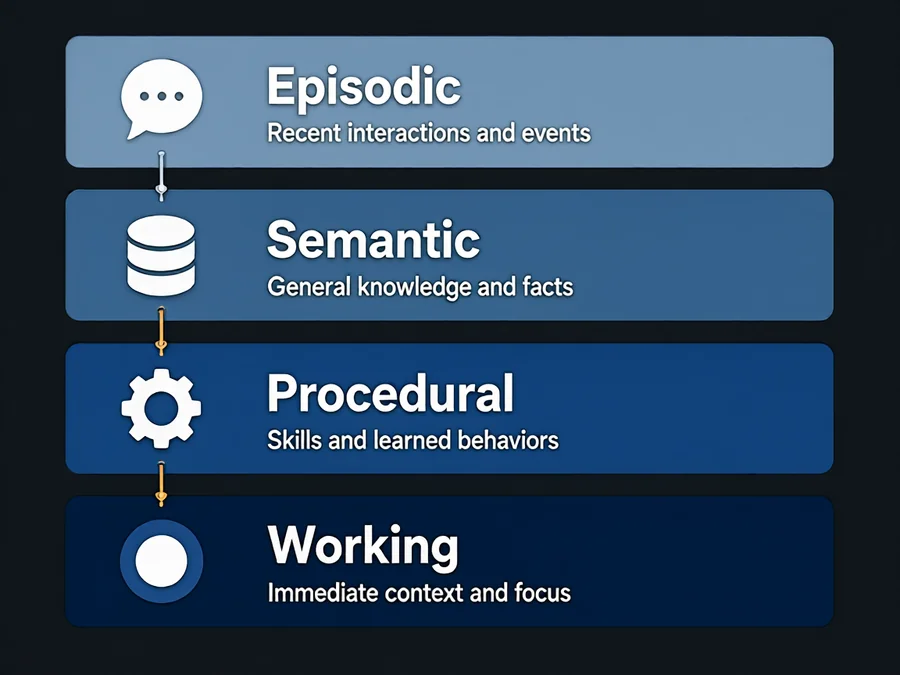
Production agents typically use a layered memory architecture. Each layer serves a different purpose and operates on a different timescale.
Episodic Memory: Session Transcript Management
Episodic memory stores the raw conversation history — every user message, assistant response, and tool call result. This is the simplest form of memory but also the most fragile, because it grows without bound.
Production systems manage episodic memory through truncation and summarization strategies. Truncation removes the oldest messages when the window approaches capacity. Summarization replaces older exchanges with condensed representations that preserve key facts and decisions.
For short, linear tasks, truncation is sufficient and cheaper. For long, multi-phase workflows where early constraints remain relevant, summarization preserves more useful context at the cost of additional inference.
Semantic Memory: Persistent Knowledge Store
Semantic memory holds facts, preferences, and procedural knowledge that persist across sessions. Unlike episodic memory, semantic memory survives conversation endings. It is the agent’s long-term knowledge base.
Common implementations include vector databases for semantic search, key-value stores for structured facts, and file-based systems for documents and notes. The critical design decision is what gets stored and how it gets retrieved.
Not everything deserves persistent storage. Transient tool results, intermediate calculations, and one-off conversational filler should not enter semantic memory. The filter is simple: would this information be useful to the agent in a future session? If not, discard it.
Procedural Memory: Skill and Pattern Library
Procedural memory encodes how the agent should behave in specific situations. These are reusable patterns — workflows, decision rules, and tool combinations — that the agent retrieves and applies when conditions match.
A production agent might have procedural memories for common patterns like “when the user asks for a code review, read the file, run the linter, summarize findings.” These patterns reduce decision latency and improve consistency across sessions.
Procedural memory answers “how” while semantic memory answers “what.” Both are essential, but they serve different retrieval paths and require different update mechanisms.
Working Context: The Active Window
Working context is the subset of all memory layers that the agent actually sees at any given moment. It is assembled dynamically from episodic recency, semantic retrieval, and procedural pattern matching.
The assembly strategy determines agent quality. A naive approach concatenates everything available. A production approach uses relevance scoring, recency weighting, and deduplication to construct a context window that maximizes signal while respecting token budgets.
Context Engineering Strategies
Memory architecture defines what exists. Context engineering defines how it gets assembled for each request. Good context engineering treats the context window as a curated artifact, not an accidental accumulation.
Tiered Storage Design
Tiered storage separates information by lifetime and access pattern:
The tier boundaries are not rigid. A document that starts in cold tier can move to warm after one retrieval and to hot after the agent references it explicitly.
Retrieval Over Eager Loading
Every token in the context window costs money and consumes model attention. Loading everything “just in case” is the fastest path to budget exhaustion and degraded performance.
Production agents use retrieval-on-demand. The agent only loads information when it has a signal that the information is relevant. The retrieval mechanism should combine vector similarity search for semantic relevance with keyword search for exact-match lookups.
Summarization as a Compression Strategy
When episodic memory grows too large for truncation to be safe, summarization preserves essential content while reducing token count. Modern models can compress hours of conversation into a few hundred tokens that retain decision points, outcomes, and unresolved questions.
Effective summarization requires explicit instructions. A prompt like “summarize preserving all tool call outcomes, user decisions, and open action items” produces usable context. Summarization should be event-driven, triggered when the window approaches a threshold or after a major decision point.
Bounded Context Windows with Explicit Policies
Set hard limits on context window usage and enforce them with explicit policies. A typical production configuration might allow 80,000 tokens with automatic summarization triggering at 70,000 and truncation at 90,000.
The policy should be configurable per workload. A customer support agent handling short queries might operate within 16,000 tokens. A code generation agent working across multiple files may need 120,000.
Common Context Management Failures
Even well-designed memory systems fail in predictable ways. Recognizing these failure modes early prevents them from becoming production incidents.
Context Drift
Context drift occurs when the agent’s understanding diverges from the original user intent. This happens when early instructions get summarized away, when tool results introduce conflicting information, or when the agent makes assumptions that accumulate across steps.
Symptoms include the agent solving a slightly different problem than requested or referencing constraints that were never stated. Prevention requires periodic intent verification — the agent should restate its understanding at key decision points.
Memory Leakage
Memory leakage happens when information from one task contaminates another. An agent working on multiple projects may retrieve semantic memory from a previous task and apply it inappropriately.
The fix is scoping. Memory should be associated with a task or project identifier, and retrieval should be filtered to the current scope.
Summary Loss
Aggressive summarization can lose critical details. A compressed conversation might preserve the overall flow but drop specific parameter values or error codes. The mitigation is to preserve structured summaries alongside free-text summaries during compression.
Retrieval Cache Staleness
Semantic memory that is never updated becomes stale. A user preference recorded weeks ago may no longer apply. The solution is freshness metadata on all stored items and periodic revalidation of high-impact memory.
Production Implementation Patterns
Pattern 1: The Stateless Workhorse
Some agents are designed to be stateless. Each request is processed independently with all necessary context retrieved fresh. This pattern works for high-volume, low-complexity tasks like customer support deflection or document QA, where eliminating memory management overhead improves throughput.
Pattern 2: The Stateful Collaborator
Stateful agents maintain conversation history and persistent memory across interactions. They remember user preferences, past decisions, and ongoing projects. This enables personalized assistance that improves over time.
The implementation requires careful attention to memory lifecycle. New sessions should load relevant semantic memory. Active sessions should manage episodic growth. Completed sessions should archive or discard context appropriately.
Pattern 3: The Hybrid Architecture
Hybrid agents combine stateless and stateful approaches. Routine requests are processed statelessly for speed, while complex multi-step workflows use stateful continuity. The routing logic determines which path handles each request based on task complexity.
Hybrid architectures balance efficiency against capability and are the most common pattern in production.
Evaluating Memory and Context Performance
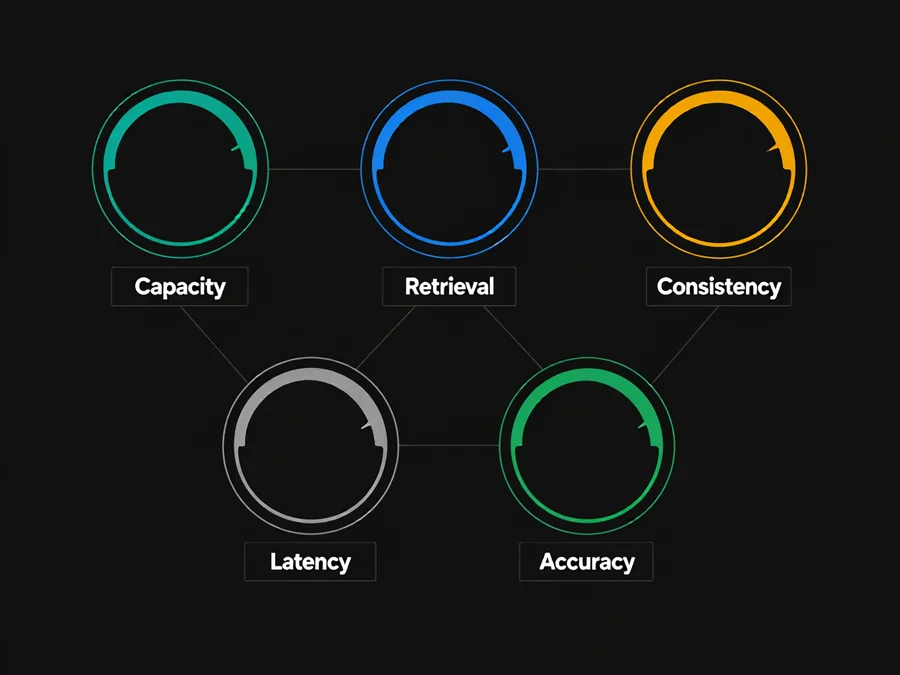
Context efficiency ratio. The proportion of tokens used for relevant information versus overhead. A healthy agent uses more than 70 percent of its context window for information that directly contributes to the response.
Retrieval accuracy. The percentage of semantic memory retrievals that prove relevant to the current task. High retrieval accuracy means the memory store is well-curated.
Decision consistency. Whether the agent’s actions remain consistent with earlier statements and decisions within the same session. Inconsistencies indicate context drift or summary loss.
Session longevity. How many tool calls the agent completes before performance degrades. A well-managed agent maintains consistent quality across hundreds of turns.
User correction rate. How often users need to repeat information the agent should already know. This is the most practical metric — it measures the user’s experience directly.
A Practical Memory Management Checklist
Before deploying an agent with memory capabilities, verify these essentials:
Frequently Asked Questions
What is the difference between episodic and semantic memory in AI agents?
Episodic memory stores the conversation history — the sequence of messages, tool calls, and responses. Semantic memory stores persistent facts, preferences, and knowledge that survive across sessions.
How many tools should an agent have active in its context?
Between five and fifteen tools typically produce the best selection accuracy. Beyond that, the model spends more tokens reading tool definitions than using them. Use dynamic tool loading to inject only the relevant subset per request.
Should I summarize the conversation or truncate it?
Summarization preserves more information but costs additional tokens. Truncation is cheaper but loses early content entirely. For workflows under twenty turns, truncation is usually sufficient. For longer workflows, summarize when approaching the threshold.
How do I prevent memory leakage between tasks?
Scope all memory by task or project identifier. Filter retrieval to the current scope. Do not share semantic memory across tasks unless explicitly requested.
What is the best way to store user preferences?
Use a structured key-value store with explicit schema. Store preferences as typed fields rather than free-text notes. Include timestamps and source confidence so the agent knows how recent and reliable each preference is.
Can an agent forget information intentionally?
Yes. Intentional forgetting is a feature. Information that is months old, never referenced again, and superseded by newer data should be archived or deleted. Set explicit retention policies and enforce them.
What role does context window size play in agent design?
Larger windows reduce retrieval frequency but increase per-request cost. The optimal size depends on your typical workflow length. Most production agents perform well with 32,000 to 128,000 token windows.
Getting Started with Production-Ready Agent Memory
Memory and context management is an architectural discipline that touches every layer of the system. The agents that succeed in production are the ones that treat context as a scarce resource, manage memory with explicit policies, and continuously monitor the signals that indicate whether their context strategies are working.
For teams building production AI agents, SmaugBrain provides the infrastructure to manage agent workflows, tool integrations, and deployment pipelines at scale. Explore the platform to see how structured agent orchestration reduces the operational complexity of memory management and context engineering.
Visit smaugbrain.com to learn more about building reliable, production-ready AI agents.