
AI Agent Credential Management: How to Secure Secrets, Tokens, and Tool Access
An AI agent can only be as secure as the credentials behind its tools. A well-designed model may follow instructions accurately, yet a leaked API key, an overpowered service account, or an unreviewed tool permission can still turn one bad action into a serious incident. Credential management is therefore not a storage detail. It is the control layer that decides what an agent can reach, how long that access lasts, and how quickly it can be stopped.
This guide explains a practical credential architecture for cloud AI agents. It covers secret storage, identity boundaries, short-lived tokens, tool scopes, approval gates, rotation, audit evidence, and incident response. The objective is not to eliminate autonomy. It is to make autonomy bounded, observable, and reversible.
Why AI Agent Credentials Require a Different Security Model
Traditional applications usually execute a known sequence of operations. An AI agent chooses among tools at runtime, builds parameters from context, and may chain several actions before a person sees the result. That flexibility creates a larger authorization problem. The same credential can be used across more paths, with less predictable inputs, and at machine speed.
The key risk is not simply that a secret might be exposed. The deeper risk is that a valid credential may authorize an action that is technically allowed but inappropriate for the current task. Prompt injection, corrupted context, a faulty integration, or an ambiguous user request can all steer an agent toward the wrong operation. Strong credential management reduces the blast radius even when another control fails.
- Secrets are copied into prompts or logs: credentials become visible outside the intended execution boundary.
- One identity serves many workflows: a compromise in a low-risk task exposes high-risk systems.
- Tokens live too long: leaked access remains useful after the task has ended.
- Tool scopes are broad: an agent that only needs to read one folder can modify an entire account.
- Approvals are disconnected from authorization: a user approves a summary, but the credential permits a wider action.
Build the Credential Boundary Before the Prompt
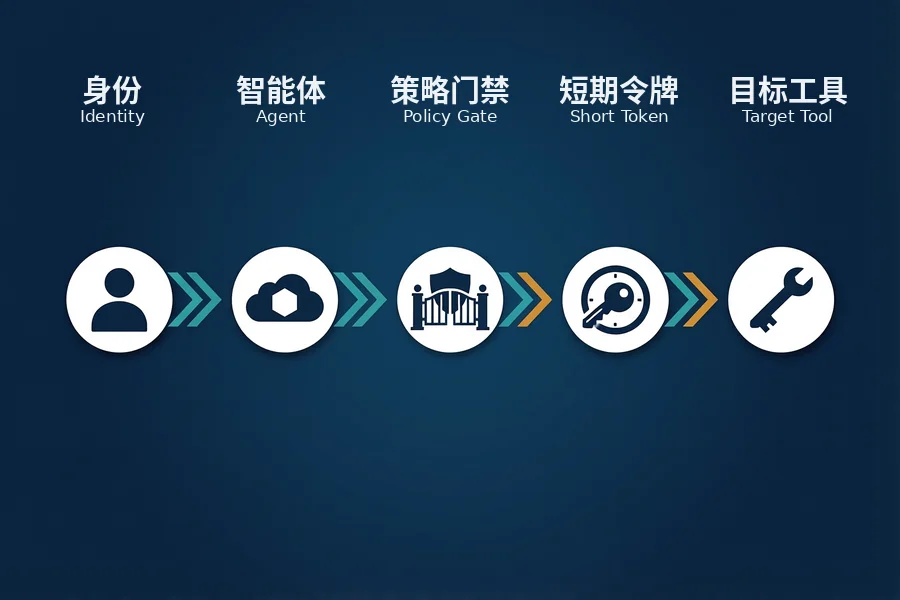
Start with the execution boundary, not the model prompt. A prompt can guide behavior, but it cannot enforce access control. The credential broker, tool adapter, cloud identity provider, and target service must enforce the final decision. Treat the model as a requester that proposes an action. A deterministic policy layer should decide whether the action receives a usable credential.
A useful architecture separates five responsibilities: the user identity, the agent runtime identity, the workflow policy, the tool-specific credential, and the audit record. Keeping these responsibilities separate makes it possible to answer who requested an action, which workflow allowed it, what resource scope was granted, and what actually happened.
| Layer | Primary Question | Recommended Control |
|---|---|---|
| User identity | Who requested the task? | Authenticated user and tenant context |
| Agent runtime | Which execution instance is acting? | Unique workload identity |
| Workflow policy | Is this action allowed now? | Tool, resource, risk, and approval rules |
| Tool credential | What exact access is granted? | Short-lived, narrowly scoped token |
| Audit evidence | What was requested and executed? | Immutable event trail with redaction |
Use Short-Lived Credentials and Just-in-Time Access
Long-lived API keys are convenient, but convenience becomes persistent exposure. Prefer workload identity, delegated authorization, or a credential broker that issues a short-lived token only after policy checks pass. The token should expire shortly after the expected action window and should be valid only for the necessary service, resource, and operation.
Just-in-time access changes the failure mode. A stolen static key may remain valuable for months. A task token limited to reading one object for several minutes has far less reuse value. Short duration is not enough by itself, however. A token that lasts five minutes but can delete every production resource is still dangerous. Duration, audience, resource, and action scope must be reduced together.
Bind Tokens to the Intended Action
Where the target system permits it, bind authorization to concrete parameters: tenant, repository, folder, record type, HTTP method, tool name, and maximum transaction size. For a messaging agent, separate reading drafts from sending messages. For a deployment agent, separate viewing status from changing infrastructure. For a content agent, separate creating a draft from publishing it.
Apply Least Privilege at the Tool and Resource Level
Least privilege is often implemented too coarsely. Giving an agent a read-only account is better than giving it administrator access, but it may still expose every customer record. Effective least privilege combines tool permissions with resource filters and workflow context.
- Allow only the tools required by the workflow.
- Restrict each tool to named resources or tenant boundaries.
- Separate read, create, update, publish, send, and delete permissions.
- Set numerical limits for spend, record count, file size, and execution volume.
- Deny privilege expansion, credential creation, and policy modification by default.
- Require a new authorization decision when the task changes materially.
This is especially important for multi-step workflows. An agent may begin with a harmless read operation and later decide that it needs to send, modify, or delete. Do not let the first authorization silently cover the entire chain. Re-evaluate authorization at each meaningful side-effect boundary. SmaugBrain workflows can combine explicit tool access, staged execution, and human checkpoints so the permission model follows the real risk of each step.
Add Approval Gates for High-Impact Actions
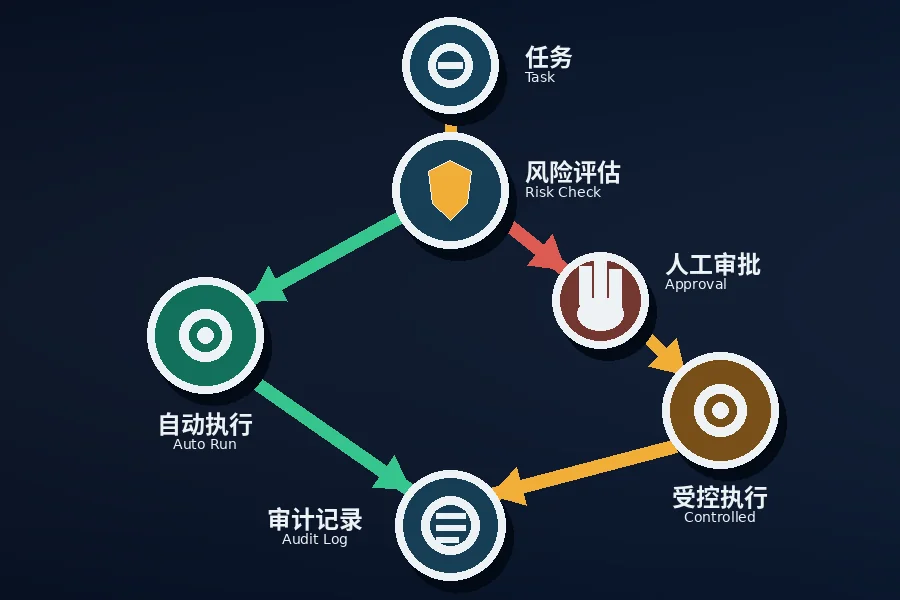
Human approval is valuable only when the reviewer sees the actual action that will be authorized. A vague message such as “approve this task” is not sufficient. The approval view should show the destination, operation, affected resources, important parameters, expected impact, and whether the action can be reversed.
The approved object should be cryptographically or logically bound to the execution request. If parameters change after approval, the authorization should be invalidated. This prevents a safe preview from becoming permission for a materially different command. For a broader decision framework, see the guide to AI agent approval workflows.
Actions That Commonly Need Explicit Approval
- Sending external messages or publishing content
- Deleting or overwriting data
- Changing access policies or creating credentials
- Spending money or committing paid resources
- Deploying to production
- Exporting sensitive information
- Executing a new tool or destination not seen in the original request
Store Secrets Outside Prompts, Memory, and Logs
An agent should receive a credential through a controlled execution channel, not through ordinary conversational context. Do not place secrets in system prompts, user-visible configuration, long-term memory, source repositories, analytics events, or tool output that returns to the model. The model usually needs to know that access is available, not the credential value itself.
Use a managed secret store or cloud identity system as the source of truth. Tool adapters should retrieve or exchange credentials at execution time, inject them directly into the outbound request, and redact sensitive headers and fields from logs. Avoid writing secrets to temporary files. If a legacy integration requires a static key, isolate it behind a narrow proxy so the agent never receives the raw value.
Log Authorization Decisions Without Logging Secrets
Security teams need enough evidence to reconstruct an incident without creating a second secret store inside the logs. Record the user, agent instance, workflow, tool, resource, requested operation, policy decision, approval reference, token identifier, timestamp, result, and error category. Do not record bearer tokens, passwords, private keys, session cookies, or full sensitive payloads.
Correlate events across the complete tool chain. A model trace without the final API result is incomplete, and an API log without the originating task lacks intent. Use a shared correlation ID so reviewers can connect the request, policy evaluation, approval, credential issuance, tool call, and outcome. The companion guide on AI agent tracing and observability explains how to build that end-to-end view.
Rotate, Revoke, and Test Recovery
Rotation should be routine, but revocation speed matters more during an incident. Maintain an inventory that maps every credential to an owner, workflow, environment, target system, allowed scope, creation time, and expiration. Credentials without a clear owner or current use should be removed.
Test the response path before it is needed. Teams should be able to disable an agent identity, revoke issued tokens, rotate static fallbacks, stop active jobs, and identify affected actions. Recovery testing should also confirm that normal workflows fail closed when the credential broker or policy service is unavailable. A fallback that silently grants broader access defeats the architecture.
Implementation Checklist for Production AI Agents
- Inventory every tool, target service, credential, and side effect.
- Create a unique workload identity for each environment and trust boundary.
- Move secrets into a managed store or identity exchange.
- Replace static keys with short-lived tokens where supported.
- Define tool-level and resource-level allow rules.
- Add transaction, volume, time, and destination limits.
- Require parameter-bound approval for high-impact operations.
- Redact credentials and sensitive payloads from all logs.
- Correlate policy, token, tool, and outcome events.
- Automate expiration, rotation, orphan detection, and revocation tests.
- Review denied requests and unusual permission patterns.
- Run failure exercises for leaked credentials and unavailable policy services.
Start with the workflows that can publish, send, delete, deploy, spend, or export. These have the clearest impact and usually reveal reusable policy patterns. Combine credential controls with cost limits as well; the AI agent budget guardrails guide covers token, tool, and spend boundaries.
Common Credential Management Mistakes
Using One Service Account for Every Agent
A shared identity makes setup easy but destroys attribution and expands blast radius. Split identities by environment, workflow class, tenant boundary, and risk level. Production and development should never share an agent credential.
Treating Read-Only as Automatically Safe
Read access can expose customer data, source code, financial records, or internal strategy. Restrict which records, fields, folders, and tenants can be read, and apply export limits to large retrievals.
Passing Secrets Through the Model Context
Even when a provider promises secure processing, unnecessary secret exposure increases risk. Keep credential values inside the trusted tool execution layer and return only sanitized results to the model.
Rotating Keys Without Testing Revocation
Rotation proves that a new credential works. It does not prove that the old credential stopped working or that active sessions were terminated. Verify both sides of the transition.
Frequently Asked Questions
Should an AI agent ever see an API key?
Usually no. The tool adapter should retrieve or exchange the credential and inject it into the outbound request. The model should receive only the capability description and a sanitized result.
Are short-lived tokens enough to secure an agent?
No. They reduce the useful lifetime of a leak, but the token must also have a narrow audience, resource scope, operation scope, and transaction limit.
How often should AI agent credentials rotate?
Prefer per-task or short-lived credentials where possible. For unavoidable static credentials, choose a schedule based on impact and exposure, automate it, and test immediate revocation separately.
What should be logged for an agent tool call?
Log the requester, agent instance, workflow, tool, resource, action, policy decision, approval reference, credential identifier, result, and correlation ID. Never log the credential value.
When is human approval required?
Use explicit approval when an action is hard to reverse, externally visible, financially significant, privilege-changing, destructive, or capable of exposing sensitive data. Bind approval to the final parameters.
Secure SmaugBrain Agent Workflows by Design
Credential security works best when it is part of workflow design rather than an emergency patch. SmaugBrain helps teams organize cloud AI agent execution around explicit tools, controlled automation, approval points, and observable outcomes. The strongest deployment gives each action only the authority it needs, only when it needs it, with evidence that can be reviewed afterward.
Ready to build bounded, production-ready AI automation? Explore SmaugBrain and design your next agent workflow with clear permissions, safer credentials, and accountable execution.