
AI Agent Knowledge Base Maintenance: Keeping Your RAG System Accurate and Current
Most organizations treat Retrieval-Augmented Generation (RAG) as a “build it and forget it” solution. But production knowledge bases decay silently. Embeddings go stale, documentation drifts from implementation, and outdated answers accumulate — all while the agent appears to function correctly. The difference between a reliable AI agent and a confidently wrong one often comes down to knowledge maintenance discipline.
This guide covers the operational practices, automated checks, and failure modes specific to maintaining production RAG systems. If you’re building AI agents that rely on retrieved context, these maintenance patterns will prevent degradation before users notice.
Why Knowledge Bases Decay in Production
Knowledge base degradation happens through several predictable mechanisms:
- Documentation drift: Source documents get updated but embeddings don’t. The retrieval system continues returning stale chunks that no longer match current implementations.
- Schema changes: API modifications, new product features, or organizational restructuring render previous answers obsolete.
- Cumulative inconsistency: Over time, conflicting information from multiple sources creates retrieval ambiguity without obvious failure signals.
- Volume creep: Without curation, knowledge bases grow disproportionately, increasing noise and reducing signal-to-noise ratio in retrievals.
These issues are particularly dangerous because they’re invisible. The agent still returns answers. Users still get responses. But accuracy drifts downward gradually — the exact pattern that’s hardest to detect without systematic checking.
Automated Freshness Checks
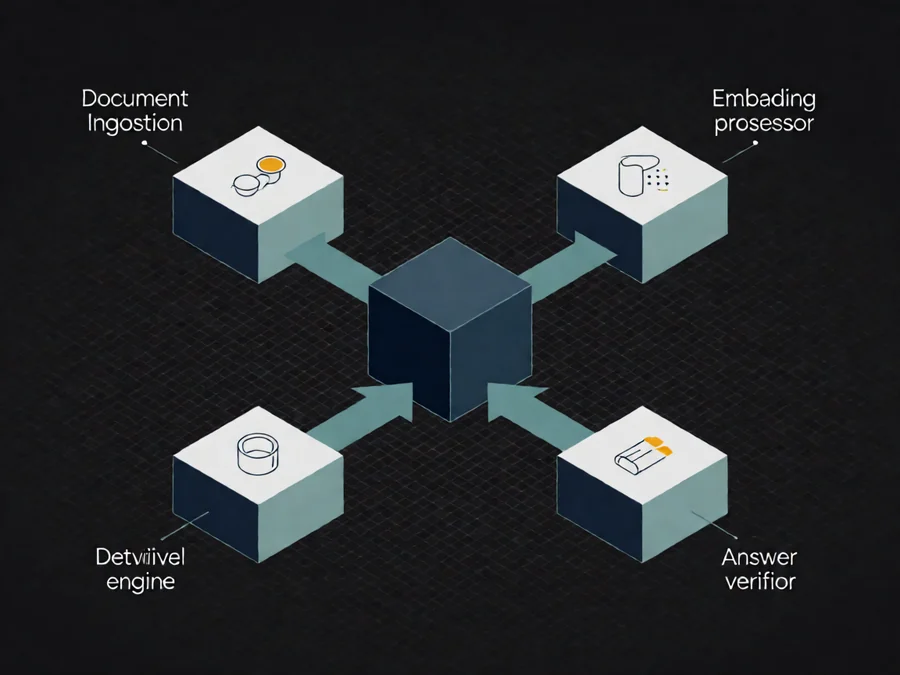
The foundation of knowledge maintenance is automated validation. Manual checks don’t scale, and “set and forget” indexing produces silent degradation. Implement these freshness checks as part of your agent’s operational routine.
Source Document Version Tracking
Every source document feeding your vector store should have a verifiable version marker. This enables deterministic re-indexing when upstream content changes. Track:
- Last-modified timestamps from source systems
- Content hashes for detecting changes without full re-download
- Source registration metadata (origin, purpose, review cycle)
When using SmaugBrain or similar orchestration platforms, schedule periodic fetch-and-hash operations against your knowledge sources. Compare current hashes against stored values. Trigger re-indexing only for changed documents — this avoids wasteful full reprocessing while catching drifts.
Answer Verification Sampling
Don’t rely solely on source-side checks. Verify answers against ground truth periodically. This catches cases where documents changed but your retrieval pipeline missed the update, or where conflicting sources produce ambiguous results.
Implementation approach: select a sample of recent queries (5-10% of production traffic), retrieve the supporting documents, and validate answers against an independent reference or human reviewer. Flag queries where retrieved context contradicts the answer, or where confidence scores are high but verification fails.
The Cleanup Lifecycle
Maintenance isn’t just about detecting problems — it’s about having systematic removal and update procedures. Knowledge base hygiene requires both addition and subtraction.
Stale Content Retirement
Implement a tiered content lifecycle:
- Active: Recently verified, high-confidence content. Ranked highest in retrieval.
- Review-queued: Sources that haven’t been verified within a defined period. Flagged for manual review.
- Deprecated: Content explicitly marked obsolete or superseded. Removed from index or flagged with deprecation warnings.
- Archived: Historical content preserved for audit but excluded from active retrieval.
This lifecycle model prevents knowledge bloat while preserving traceability. Deprecated content can be restored if needed, but won’t contaminate active retrievals.
Duplicate and Conflict Resolution
Multi-source knowledge bases accumulate conflicting information naturally. When API documentation describes v1 behavior and a blog post describes v2, the embedding model may average these into ambiguous representations that retrieve poorly for either interpretation.
Resolution strategy: maintain a source authority hierarchy. Official documentation beats blog posts, changelogs beat release notes, and recent versions beat legacy documentation. When conflicts exist, prefer higher-authority sources during retrieval ranking rather than attempting to merge contradictory content into single chunks.
Monitoring Knowledge Health
Production monitoring should include knowledge-specific metrics beyond standard latency and error rates. These indicators catch degradation before it impacts users.
| Metric | What It Catches | Alert Threshold |
|---|---|---|
| Embedding recency distribution | Stale source documents | >20% older than 30 days |
| Retrieval confidence variance | Ambiguous or conflicting content | Standard deviation >0.15 |
| Query-answer consistency rate | Systematic hallucination patterns | <90% over 7 days |
| Source change detection rate | Missed updates in pipeline | Zero changes detected when sources modified |
| Deprecated content ratio | Knowledge bloat | >15% of active index |
These metrics feed directly into your agent’s health dashboard. When anomalies appear, trigger targeted maintenance rather than waiting for scheduled cleanup cycles.
Automated Update Pipelines
Manual knowledge maintenance doesn’t scale. Production systems need automated pipelines that handle routine updates without human intervention, while flagging edge cases for review.
Scheduled Re-Indexing Triggers
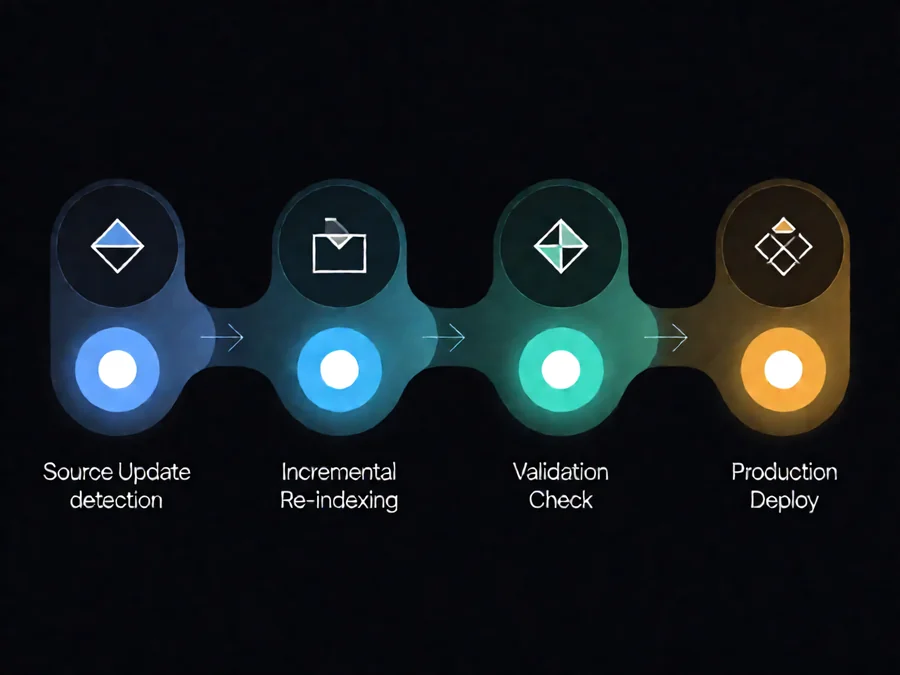
Configure incremental re-indexing based on source change signals rather than fixed schedules. When your source control system reports a commit to documentation repositories, or when API version endpoints return new changelog entries, trigger targeted re-processing for affected content only.
SmaugBrain’s scheduling capabilities make this straightforward: create a cron job that checks source modification times, computes change hashes, and queues affected documents for re-embedding. The pipeline processes only changed content, reducing compute cost by 60-80% compared to full re-indexing.
Validation Before Deployment
Never push knowledge updates directly to production. Use a staging index for validation:
- Re-embed changed documents into a temporary vector store
- Run sample queries against both staging and production indexes
- Compare retrieval results — flag significant shifts in top-k documents
- Human-review flagged changes before promoting staging to production
This staged approach catches “update regressions” — cases where the re-indexing process introduces errors or where changed content breaks previously accurate answers.
Embedding Quality and Chunking Strategy
The quality of your knowledge retrievals depends heavily on how documents are chunked and embedded. Poor chunking strategy amplifies the maintenance problems described above, making it harder to detect and fix stale information.
Chunk Size and Overlap
Chunk size directly affects retrieval precision. Too small, and context gets fragmented across multiple retrievals. Too large, and irrelevant information dilutes the signal. Aim for 200-500 tokens per chunk depending on document type, with 50-100 token overlap to preserve continuity across boundaries.
Maintain chunk metadata that records source document, position, and semantic boundaries. This enables targeted re-chunking when sources update — you only reprocess affected chunks rather than rebuilding the entire index.
Semantic vs. Syntactic Boundaries
Content boundaries matter more than arbitrary token counts. Chunk at natural document boundaries: API endpoint sections, configuration parameters, procedure steps. A chunk that splits a code example from its explanation creates retrieval confusion that no amount of maintenance can fully resolve.
Common Pitfalls in Knowledge Maintenance
Organizations implementing RAG maintenance often encounter these predictable failures:
The Freshness Fallacy
Assuming recent embeddings equal accurate answers. Fresh content can still be wrong, and stale content can occasionally remain correct when the underlying facts haven’t changed. Always pair recency checks with verification sampling.
The Volume Illusion
Adding more documents improves retrieval. In practice, uncurated growth increases noise faster than signal. Aggressive deduplication and quality scoring often improve answer accuracy more than expanding source coverage.
The Silent Override
One high-confidence outdated answer suppressing correct new answers. When embeddings for deprecated content remain semantically strong while new content starts weak, retrieval ranking favors stale information. Combat this with explicit recency weighting in your retrieval strategy.
FAQ
How often should I re-index my knowledge base?
Re-index on source change, not on calendar. For rapidly changing documentation (API docs, changelogs), check daily. For stable internal wikis, weekly or monthly may suffice. The key is detecting when sources change, not maintaining arbitrary refresh intervals.
What’s the difference between knowledge maintenance and monitoring?
Maintenance refers to proactive actions: updating embeddings, retiring stale content, resolving conflicts. Monitoring refers to reactive detection: alerting when answer quality drops or retrieval patterns shift. Both are necessary — monitoring without maintenance is notification without resolution; maintenance without monitoring is effort without verification.
Should I use separate indexes for different knowledge domains?
Yes, when domains have different update rhythms or authority sources. Technical documentation, product FAQs, and compliance policies often change at different rates. Separate indexes enable domain-specific refresh schedules and reduce cross-domain noise. Route queries to the appropriate index based on query classification rather than searching all indexes simultaneously.
How do I handle conflicting information from multiple sources?
Establish a source hierarchy before conflicts arise. Official documentation supersedes community posts, recent versions supersede legacy ones, and authoritative sources supersede mirrors. When the retrieval system encounters conflicting chunks, weight them by source authority rather than embedding similarity alone. Log conflicts for manual resolution when authority levels are equal.
What metrics indicate my knowledge base needs cleanup?
Track three leading indicators: (1) retrieval confidence variance increasing over time, (2) user dissatisfaction or correction rates climbing, (3) the ratio of deprecated content to active content exceeding 15%. Any one of these signals warrants immediate audit; all three together indicate systematic degradation requiring full cleanup.
Can I automate conflict detection?
Partial automation is possible. Flag chunks where semantic similarity exceeds a threshold but content hashes diverge significantly — this indicates paraphrased or versioned content that may conflict. However, true conflict resolution requires semantic understanding beyond current automated approaches. Use automated detection to surface candidates; reserve human judgment for actual resolution decisions.
Implementation Checklist
Before deploying a production RAG system, verify these maintenance capabilities:
- Source version tracking implemented for all indexed documents
- Incremental re-indexing pipeline tested and scheduled
- Answer verification sampling configured (minimum 5% of traffic)
- Deprecated content lifecycle defined and enforced
- Knowledge health metrics integrated into monitoring dashboard
- Staging-to-production promotion workflow established
- Conflict resolution hierarchy documented and applied in retrieval
Knowledge base maintenance isn’t optional overhead — it’s the difference between an AI agent that degrades gracefully and one that fails silently. Implement these patterns early, and your retrieval system will stay accurate long after the initial deployment excitement fades.
Ready to implement production-grade AI agent workflows? Visit SmaugBrain to explore scheduling, monitoring, and automation capabilities designed for reliable agent operations.