
AI Agent Orchestration Patterns: Choosing the Right Architecture for Production
Building a single AI agent is straightforward. Building a system where multiple agents coordinate, delegate, and resolve conflicts at scale is where most teams hit their first production wall. The difference between a prototype that works in testing and one that runs reliably in production often comes down to the orchestration pattern you choose.
Orchestration in this context refers to how you structure agent interactions: who decides when to act, how agents share state, and what happens when one agent fails. The pattern you select affects latency, cost, reliability, and how hard your system is to debug when something goes wrong.
Why Orchestration Matters More Than You Think
A common mistake is to treat orchestration as an afterthought. You build one agent that handles the core task, then add another when a edge case appears. Before long, you have a tangle of agents that occasionally work but frequently step on each other, lose context, or produce inconsistent outputs.
The agents that succeed in production share one trait: their orchestration pattern was chosen deliberately, not accidentally. The pattern determines how agents communicate, how failures are contained, and how the system scales when request volume changes.
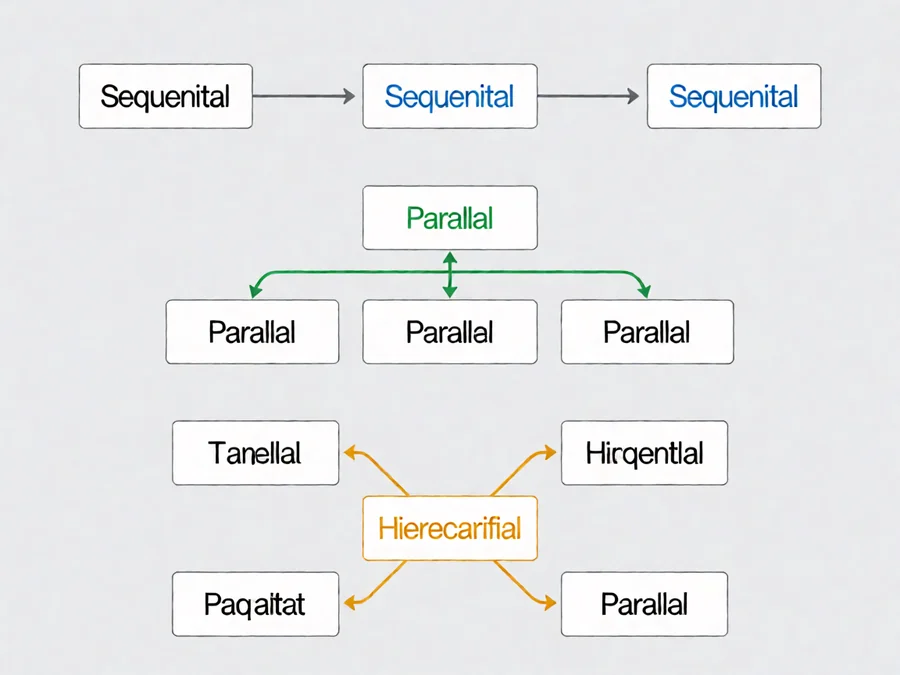
The Three Core Orchestration Patterns
Every production agent system falls into one of three fundamental patterns. Understanding the trade-offs between them is the foundation for making the right architectural decision.
Sequential Orchestration
In sequential orchestration, agents execute one after another in a fixed order. Each agent receives the output of the previous agent as its input. This is the simplest pattern and the most intuitive to reason about.
Sequential orchestration works well when tasks have clear dependencies. A research agent gathers information, passes it to a synthesis agent, which passes its output to a formatting agent. Each step builds on the last, and failures are easy to trace because the execution path is linear.
The limitation is obvious: sequential patterns struggle with tasks that require parallelism or dynamic branching. If the research phase uncovers an unexpected angle, the fixed sequence cannot adapt without manual intervention.
Parallel Orchestration
Parallel orchestration launches multiple agents simultaneously, each working on an independent subtask. A coordinator agent aggregates results once all agents complete. This pattern maximizes throughput when subtasks are truly independent.
Parallel orchestration shines in scenarios like multi-source research, where you need to query several databases or API endpoints at once, then synthesize the combined results. It also works well for A/B testing agent outputs, where you run multiple approaches and select the best result.
The challenge with parallel orchestration is coordination overhead. You need a reliable way to track which agents have completed, handle partial failures, and merge results that may have inconsistent formats or conflicting conclusions.
Hierarchical Orchestration
Hierarchical orchestration introduces a manager agent that delegates tasks to worker agents and resolves conflicts between them. The manager maintains global context, tracks progress, and decides when to escalate or reroute work.
This pattern is essential for complex workflows where tasks are interdependent but not strictly sequential. A code review agent might delegate linting to one worker, architecture review to another, and security scanning to a third, then synthesize findings into a unified report.
Hierarchical orchestration adds complexity but provides the flexibility needed for real-world production workloads. The manager agent acts as a single point of coordination, preventing worker agents from stepping on each other or duplicating effort.
Decision Framework: Which Pattern Fits Your Use Case
Choosing between sequential, parallel, and hierarchical orchestration requires evaluating your specific constraints. The following framework helps you make the decision systematically.
| Factor | Sequential | Parallel | Hierarchical |
|---|---|---|---|
| Task dependency | Linear, fixed order | Independent subtasks | Complex, dynamic dependencies |
| Latency tolerance | Low (serial execution) | High (concurrent execution) | Moderate (coordination overhead) |
| Fault isolation | Easy (single path) | Moderate (independent failures) | Complex (manager dependency) |
| Implementation complexity | Low | Medium | High |
| Best for | Pipelines, ETL, simple workflows | Batch processing, A/B testing | Complex decision-making, dynamic routing |
Common Pitfalls in Agent Orchestration
Even teams that understand the patterns often make the same mistakes. Recognizing these pitfalls early saves significant debugging time later.
Pitfall 1: Assuming Independence When Dependencies Exist
Parallel orchestration fails silently when agents have hidden dependencies. Agent A modifies a shared resource that Agent B reads. Both run concurrently, producing inconsistent results. The fix is to explicitly declare dependencies and use locks or message queues to enforce ordering where needed.
Pitfall 2: Over-Orchestrating Simple Tasks
Not every task needs a coordinator agent. Adding hierarchical orchestration to a simple three-step pipeline introduces unnecessary complexity without meaningful benefit. Start with the simplest pattern that handles your requirements, then escalate only when the pattern shows clear limitations.
Pitfall 3: Ignoring State Management
Agent orchestration systems accumulate state: conversation history, tool outputs, intermediate results. Without explicit state management, agents lose context across steps, duplicate work, or make decisions based on stale information. Design your state layer before you design your agent layer.
Pitfall 4: No Fallback When Coordinators Fail
In hierarchical orchestration, the manager agent becomes a single point of failure. If it crashes or times out, the entire system stalls. Implement health checks, timeouts, and fallback workers that can take over when a coordinator becomes unresponsive.
Real-World Example: Multi-Stage Research Workflow
Consider a research assistant that needs to gather information from multiple sources, synthesize findings, and produce a structured report. A purely sequential approach would query sources one by one, then synthesize, then format. This works but takes too long for time-sensitive research.
A parallel approach would query all sources simultaneously, then synthesize and format sequentially. This reduces latency significantly but requires careful handling of results that arrive in different formats or contain conflicting information.
A hierarchical approach adds a coordinator that dynamically adjusts the workflow based on what it finds. If one source is unavailable, the coordinator reroutes to alternative sources. If two sources conflict, the coordinator flags the conflict for human review. This adds complexity but produces more robust results.
The right choice depends on your latency requirements, error tolerance, and the variability of your data sources. There is no universal best pattern.
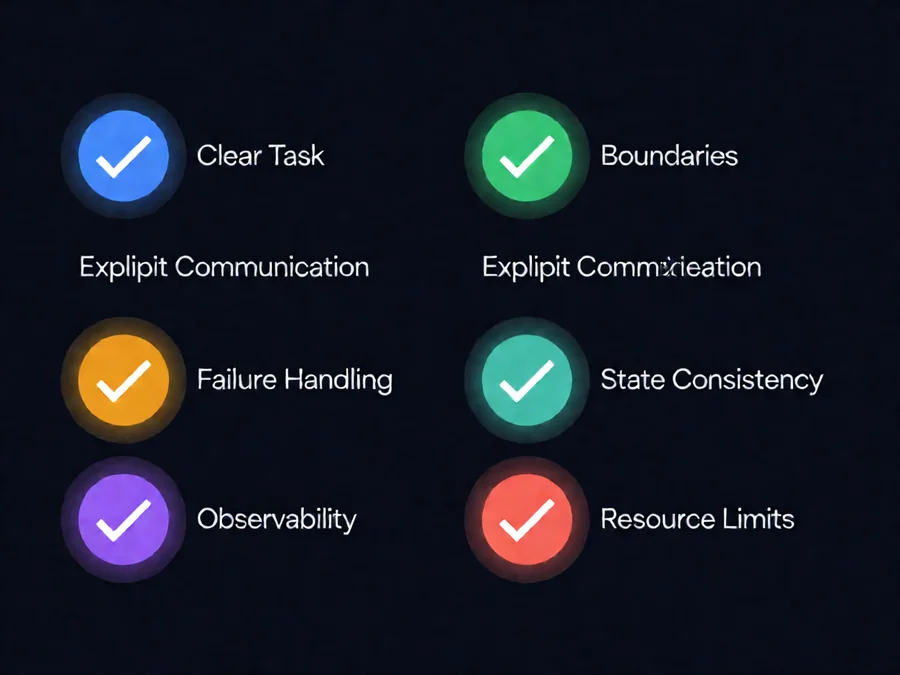
Implementation Checklist
Before deploying any orchestration pattern to production, verify the following:
- Clear task boundaries: Each agent has a single, well-defined responsibility. Ambiguous boundaries lead to overlap and missed coverage.
- Explicit communication protocol: Agents communicate through a defined interface, not through shared memory or implicit assumptions.
- Failure handling: Every agent has a defined behavior when it fails: retry, escalate, or return a fallback response.
- State consistency: Shared state is updated atomically, and agents can detect and recover from stale reads.
- Observability: Every orchestration step is logged with sufficient context to reconstruct what happened when something goes wrong.
- Resource limits: Parallel agents are bounded to prevent resource exhaustion under load.
When to Stick With a Single Agent
Orchestration adds capability, but it also adds cost and complexity. If your task can be completed reliably by a single well-designed agent, do not introduce orchestration just for scalability. Many production systems fail not because they lack orchestration, but because they added it unnecessarily.
Evaluate whether orchestration is actually needed by asking: can a single agent handle the full workflow within acceptable latency and cost? If yes, keep it simple. If no, choose the minimal orchestration pattern that solves your problem.
FAQ
How do I know when my agent system needs orchestration?
Introduce orchestration when a single agent consistently fails to complete complex workflows within acceptable latency or quality bounds. Common signals include frequent timeout errors, inconsistent outputs across similar requests, or the need to parallelize independent subtasks.
Can I switch orchestration patterns after deployment?
Yes, but expect significant refactoring. Orchestration patterns affect how agents communicate, share state, and handle failures. Switching patterns often requires redesigning agent interfaces and state management. Plan your initial pattern choice carefully.
What is the most common orchestration failure mode?
The most common failure is silent state corruption: one agent writes to shared state while another reads it concurrently, producing inconsistent results without any visible error. Always use explicit state management and atomic updates.
How many agents is too many for one orchestration system?
There is no hard limit, but practical experience suggests that systems with more than 10-15 active agents become difficult to debug and monitor. Consider breaking large systems into smaller, coordinated subsystems rather than scaling a single orchestrator.
Do I need a dedicated coordinator agent for parallel orchestration?
Not necessarily. Simple parallel orchestration can use a lightweight orchestrator that launches tasks and collects results. Reserve dedicated coordinator agents for hierarchical patterns where dynamic decision-making and conflict resolution are required.
Conclusion
Orchestration pattern selection is not a theoretical exercise. It determines how your agent system behaves under real load, how easy it is to debug when things go wrong, and how much engineering effort is required to maintain it. Choose the simplest pattern that handles your requirements, validate it with real traffic, and only add complexity when the pattern shows clear limitations.
The agents at SmaugBrain are designed to support all three orchestration patterns, with built-in state management, failure handling, and observability that make production deployment straightforward.