
# AI Agent Error Handling and Retry Strategies: A Production Guide
Introduction
An AI agent that works flawlessly in development but crashes unpredictably in production is a familiar pattern. The difference between a prototype and a production system is rarely intelligence — it is resilience. Errors are inevitable: LLM APIs rate-limit you, network connections drop, downstream services return unexpected payloads, and tools time out mid-execution. Without systematic error handling, these transient failures cascade into failed workflows, duplicated actions, and frustrated users.
This guide covers production-ready error handling and retry strategies for AI agents. You will learn how to classify errors correctly, implement bounded retries with exponential backoff, use idempotency keys to prevent duplicates, design fallback chains, and apply circuit breakers.
Why Error Handling Is Different for AI Agents
Traditional software error handling follows predictable paths. An HTTP request returns a status code you can branch on. AI agents operate differently because their execution flow is dynamic, driven by language model decisions rather than static control flow.
Three characteristics make agent error handling uniquely difficult:
Non-deterministic execution paths. The same input can produce different tool-call sequences across runs. A retry strategy must handle every possible failure point, not just a fixed set of branches.
Stateful side effects. Unlike pure functions, agents modify external state — sending emails, updating databases, triggering payments. A naive retry can duplicate these effects if the original action succeeded but the response was lost.
Opaque failure modes. An LLM may return a malformed JSON response, skip a required tool call, or hallucinate parameters. These are logic errors, not transport errors, and require different recovery strategies.
Production agents need layered defenses: system-level retries for infrastructure failures, verification-before-retry for ambiguous outcomes, and model-aware recovery for reasoning errors.
Classifying Errors Before Implementing Retries
The most common mistake in agent error handling is treating all failures the same. Retrying an authentication error wastes tokens. Not retrying a rate limit loses work unnecessarily. Classification happens at three levels.
Transport-Level Errors
Transport errors occur before application logic executes. They include connection timeouts, DNS resolution failures, and dropped TCP connections. These are almost always transient.
| Error Type | Retry? | Strategy |
|---|---|---|
| Connection refused | Yes | Exponential backoff, 3–5 attempts |
| Timeout | Yes | Shorter backoff cap (10–30s) |
| DNS failure | Conditional | Retry once after 5s |
| TLS error | No | Fail fast; requires manual intervention |
Transport retries belong to the orchestration layer. The LLM should never see these errors — the system handles them silently.
Service-Level Errors
Service errors come from reachable endpoints that reject the request. These require inspection of HTTP status codes.
| Status Code | Retry? | Strategy |
|---|---|---|
| 429 | Yes | Parse Retry-After header; back off accordingly |
| 500 | Conditional | Retry once with backoff; escalate after exhaustion |
| 502/503 | Yes | Standard exponential backoff |
| 400 | No | Fix parameters; do not retry identical request |
| 401/403 | No | Fail fast; credentials need rotation |
Rate-limit responses deserve special attention. Modern LLM providers include a Retry-After header. Always prefer the provider’s guidance over a generic backoff calculation.
Application-Level Errors
Application errors originate from the agent’s own logic: invalid tool arguments, missing required fields, or malformed model outputs. These are rarely recoverable through retry. Instead, they require structured error reporting back to the model so it can adjust its approach.
When an application error occurs, return it as clear text. If a search tool receives an empty query, return "Search requires a non-empty query string" instead of raising an unhandled exception. The agent sees the error context and can reformulate the request.
Bounded Retry with Exponential Backoff and Jitter
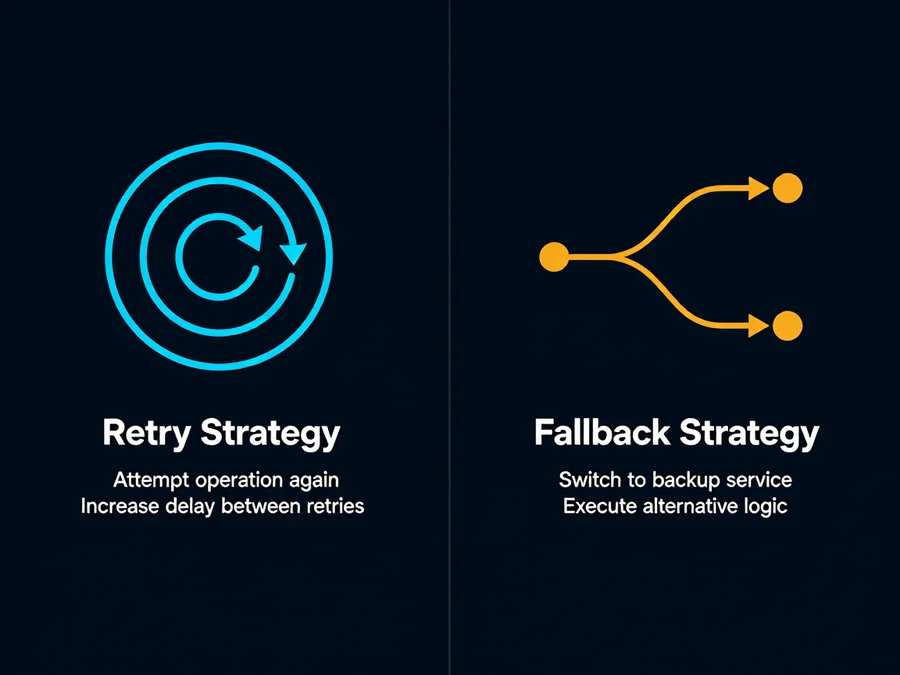
Exponential backoff is the foundation of production retry logic. You wait increasingly longer intervals between attempts, giving overloaded services time to recover.
The standard formula:
delay = initial_delay × backoff_factor^attemptWith initial_delay = 1s and backoff_factor = 2, a four-attempt retry produces delays of 1s, 2s, 4s, and 8s — a total wait of 15 seconds.
Raw exponential backoff causes the thundering-herd effect: when many agents retry simultaneously after an outage, they all wake up at the same moments and flood the recovering service. The solution is jitter — adding random variation to each delay.
import random, time

def delayed_retry(max_attempts, initial_delay=1.0, backoff_factor=2.0, max_delay=60.0):
    for attempt in range(max_attempts):
        try:
            return execute_operation()
        except TransientError as e:
            if attempt == max_attempts - 1:
                raise
            delay = min(initial_delay * (backoff_factor ** attempt), max_delay)
            sleep_time = random.uniform(0, delay)
            time.sleep(sleep_time)
Bounded retries must have a hard limit. Set max_attempts based on latency tolerance — typically 3 to 5 for user-facing operations. Log every retry attempt with the error type, attempt number, and calculated delay.
Idempotency Keys: Making Retries Safe
Retries are safe only when the operation is idempotent — executing it multiple times produces the same result as executing it once. Most write operations are not naturally idempotent.
Idempotency keys associate a deterministic identifier with each logical operation. When the downstream service receives the same key twice, it returns the cached result instead of performing the action again.
import hashlib

def make_idempotency_key(agent_id, operation_type, payload):
    material = f"{agent_id}\x00{operation_type}\x00{payload}"
    return hashlib.sha256(material.encode()).hexdigest()[:32]
Key generation rules:
When the underlying API does not support idempotency keys natively, implement a client-side idempotency store. Cache the result of each successful operation keyed by the identifier. On retry, check the cache first.
Verify-Before-Retry: Resolving Ambiguous Outcomes
The hardest failure mode is the ambiguous outcome: the agent sends a tool request, receives a timeout, and has no way to know whether the action actually executed. Naive retry creates duplicates. Verified retry prevents them.
The verify-before-retry pattern adds a postcondition check:
1. Execute the operation with an idempotency key.
2. If the response indicates success, proceed normally.
3. If the response is an error or timeout, query current state to verify whether the intended effect exists.
4. If verification confirms success, treat the operation as completed.
5. If verification confirms failure, retry with the same idempotency key.
This maps to the distributed-systems principle of at-least-once delivery with idempotent consumers. Verification is especially important for compound operations where a mid-sequence failure leaves partial state behind. Resume from the first unverified point rather than retrying everything.
Fallback Chains for Persistent Failures
When retries are exhausted, the agent needs a fallback path. Fallbacks fall into two categories.
Tool-level fallbacks swap one implementation for another: primary/secondary tools, cached results, or simplified operations when complex calls fail repeatedly.
Model-level fallbacks address reasoning-layer failures: same-provider tier swaps, cross-provider failover, or local/offline fallbacks for critical paths.
Fallback configuration should be explicit and testable. Run periodic chaos tests that simulate provider outages. Do not discover fallback failures during an actual incident.
Circuit Breakers: Protecting Systems From Themselves

A circuit breaker prevents continuous calls to a degraded service. When sequential failures exceed a threshold, the breaker opens and short-circuits further requests for a cooldown period.
The circuit breaker has three states:
Closed. Normal operation. Failure count increments on each error.
Open. Requests rejected immediately. A timer tracks cooldown.
Half-open. After cooldown, one probe request passes through. Success closes the breaker; failure reopens it.
Configure circuit breakers per-dependency. Your agent might call five different tools — each has different reliability characteristics. A payment gateway failure deserves immediate circuit breaking; a non-critical analytics tool tolerates more failures.
Circuit breakers complement retry logic. Use retries for transient errors within a single call, and circuit breakers to stop repeated attempts against a persistently broken dependency.
Error Recovery at the Model Level
System-level retries handle infrastructure failures. Agents also encounter model-caused failures: hallucinated tool parameters, skipped steps, circular reasoning, or incorrect plan execution.
Structured error feedback. Return errors as clear text that the model can parse. Include the tool name, validation failure, and expected format hints.
Bounded reflection loops. Some frameworks allow agents to revise their approach after failures. Enforce a maximum number of revision cycles — typically 2–3. When exhausted, escalate to a predefined handler.
Human escalation paths. Not every failure can be automated. Escalation should include a task summary, the specific error, attempted recovery actions, available human options, and a unique reference ID.
Real-World Example: Building a Resilient Research Agent
Consider an AI agent that researches market trends using three tools: a web search API, a news aggregation API, and a report generator.
Search layer. Each search uses bounded retry with full-jitter exponential backoff (3 attempts, 1s initial, 2.0 factor, 30s max). The search API returns 429 on rate limits — the retry logic parses the `Retry-After` header. If all searches exhaust retries, the agent proceeds with collected results rather than failing entirely.
News layer. A circuit breaker monitors 502 frequency. After 5 consecutive 502s, the breaker opens for 60 seconds. During open state, cached news results with a freshness timestamp are used.
Report layer. Every write carries an idempotency key derived from the agent session ID and report title. If the write times out, the agent verifies whether the report was saved before retrying. A client-side cache stores recent write results.
Model layer. If synthesis produces malformed output, the agent receives structured validation feedback and regenerates with corrected instructions. A reflection counter limits regeneration to 2 attempts.
This layered approach means individual tool failures degrade gracefully rather than crashing the pipeline.
Common Pitfalls
Pitfall 1: Retrying non-retryable errors. Treating every exception the same wastes tokens on auth failures and creates infinite loops on validation errors. Classify errors explicitly.
Pitfall 2: Non-deterministic idempotency keys. Generating a new UUID per retry defeats deduplication. Derive keys from stable inputs.
Pitfall 3: Retrying without verification on mutating operations. Assuming a failed request never executed is the fastest path to duplicate payments and corrupted data. Always verify the postcondition.
Pitfall 4: Retry limits too high. Ten retries add minutes of latency. For user-facing operations, 3 attempts is sufficient. Higher limits belong in background jobs.
Pitfall 5: Missing the half-open transition. Without a probe request, breakers stay open permanently after brief outages.
Pitfall 6: Debug-level logging only. Log every retry with context — attempt number, error type, elapsed time, and idempotency key. Structure logs as JSON for machine parsing.
FAQ
Q: How many retry attempts are appropriate?
A: Three to five is standard. User-facing operations should use 3; background batch processing can tolerate 5–10. Always pair with a maximum delay cap.
Q: Should I retry when the LLM returns an error?
A: Transport errors (timeouts, 503s) should be retried at the orchestration layer. Output-format errors should be returned to the model as structured feedback for self-correction.
Q: What is the difference between a fallback and a retry?
A: A retry repeats the same operation. A fallback executes a different operation achieving the same goal. Retries address transient failures; fallbacks address persistent ones. Both are necessary.
Q: Can idempotency keys cause issues with legitimate duplicates?
A: Yes, if two distinct users initiate the same operation. Always scope keys to include a unique user or session identifier.
Q: How do I test error handling?
A: Introduce controlled faults using chaos engineering. Mock upstream services to return specific error codes. Verify retries, fallbacks, and circuit breakers activate as expected. Test each failure mode individually and in combination.
Conclusion
Production-ready AI agents treat error handling as a first-class architectural concern. The patterns covered here — error classification, bounded exponential backoff with jitter, idempotency keys, verify-before-retry, fallback chains, circuit breakers, and model-aware recovery — form a layered defense that keeps agents running when individual components fail.
Start with error classification. Add bounded retries for transient errors. Introduce idempotency keys for side-effect operations. Implement verify-before-retry for ambiguous outcomes. Design fallback chains and deploy circuit breakers. Build model-level recovery for reasoning errors that infrastructural resilience cannot fix.
The agents that survive in production are not the smartest ones. They are the ones that fail gracefully, recover systematically, and keep delivering value even when individual pieces break.
—
Ready to build resilient AI agents? Explore SmaugBrain for production-grade agent workflows, error handling templates, and deployment guides.