
# AI Agent RAG Implementation: A Production Guide to Building Effective Retrieval Systems
AI Agent RAG Implementation: A Production Guide to Building Effective Retrieval Systems
Retrieval-Augmented Generation (RAG) has become the standard architecture for production AI agents that need to ground their responses in factual, up-to-date information. Unlike pure prompt engineering or fine-tuning approaches, RAG gives your agent access to a dynamic knowledge base without retraining the underlying model.
However, implementing RAG correctly is significantly harder than the tutorials suggest. The difference between a RAG system that halucinates confidently and one that retrieves accurately often comes down to implementation details that most guides skip entirely.
This guide covers the practical decisions you need to make when building a production RAG system for AI agents—chunking strategies, embedding models, retrieval architectures, reranking, and the evaluation metrics that actually matter.
What Is RAG and Why AI Agents Need It
RAG augments a language model’s response generation with externally retrieved information. The agent queries a knowledge base, retrieves relevant documents or passages, and incorporates them into the generation context alongside the user’s original prompt.
For AI agents specifically, RAG solves three critical problems:
- Knowledge freshness: Agents can access current information without model retraining
- Factual grounding: Responses cite sources rather than generating plausible-sounding fabrications
- Domain specificity: Agents can operate in specialized contexts using proprietary or internal documentation
Without RAG, agents either rely on training data cutoffs, external API calls for each query, or suffer from hallucination when confronting out-of-distribution questions.
Chunking Strategies That Actually Work
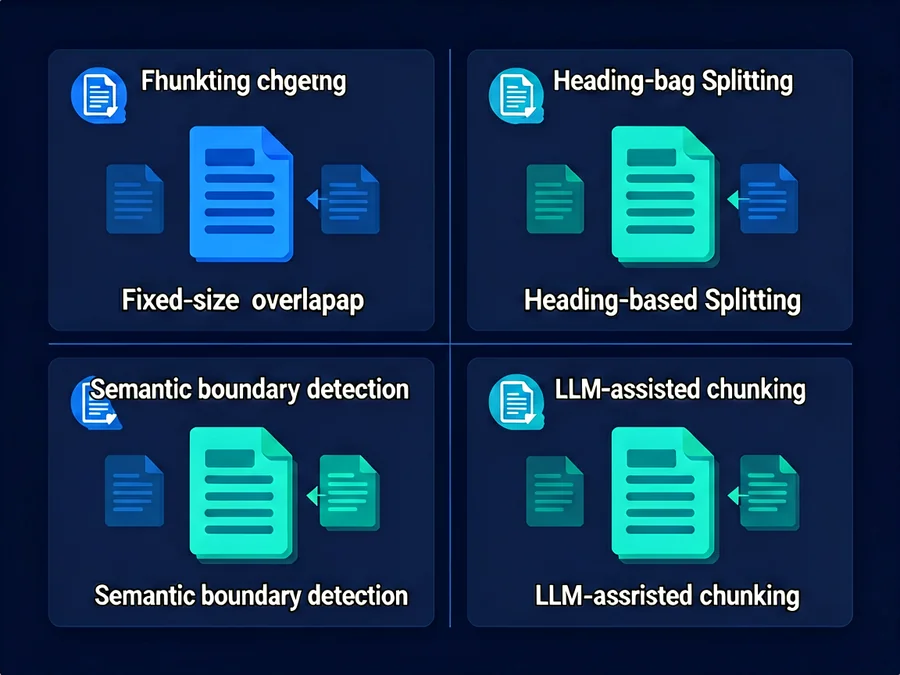
The way you segment documents before embedding determines retrieval quality more than any other single factor. Poor chunking creates noise; good chunking preserves semantic boundaries.
Fixed-Size Chunking with Overlap
The simplest approach splits documents into fixed-size chunks with overlapping boundaries. Typical parameters:
- Chunk size: 256–1024 tokens
- Overlap: 50–200 tokens
- Separator: paragraph breaks, section headers, or natural boundaries
Fixed-size chunking works adequately for structured documents like FAQs or manual entries. However, it frequently splits coherent concepts across chunk boundaries, causing retrieval to return incomplete context fragments.
Semantic Chunking
Semantic chunking identifies natural breakpoints where the document’s topic shifts significantly. Techniques include:
- Heading-based splitting: Use document structure (H1, H2, H3) as boundaries
- Length-based grouping: Group sentences until a length threshold, then evaluate semantic coherence
- LLM-assisted chunking: Use the model itself to identify logical sections
Semantic chunking typically produces higher retrieval precision because each chunk represents a complete thought or concept. The tradeoff is computational overhead during ingestion.
| Chunking Strategy | Best For | Avg. Precision | Implementation Complexity |
|---|---|---|---|
| Fixed-size with overlap | Structured docs, FAQs | Medium | Low |
| Heading-based | Technical documentation | High | Low |
| Semantic boundary detection | Unstructured text | High | Medium |
| LLM-assisted | Complex domain texts | Very high | High |
Multi-Granularity Chunking
Advanced RAG systems maintain multiple chunk sizes simultaneously. Small chunks capture specific details; large chunks provide contextual grounding. During retrieval, the system can combine results across granularities or select based on query complexity.
Embedding Model Selection
Your embedding model determines how well the system understands semantic similarity between queries and documents. The landscape has shifted dramatically since 2023.
Production-Ready Embedding Models
| Model | Dimensions | Max Tokens | Typical Use Case |
|---|---|---|---|
| text-embedding-3-large | 3072 | 8191 | General purpose, high accuracy |
| text-embedding-3-small | 1536 | 8191 | Cost-sensitive deployments |
| mxbai-embed-large-v1 | 1024 | 512 | Open source alternative |
| nomic-embed-text-v1.5 | 768 | 8192 | Long documents, local deployment |
Embedding Model Tradeoffs
Larger embedding dimensions generally correlate with better retrieval quality but increase storage costs and reduce vector search performance. The 3072-dimensional text-embedding-3-large provides state-of-the-art MTEB benchmark scores but requires more memory per vector.
For AI agents processing hundreds of thousands of documents, consider dimensionality reduction after initial embedding, or use quantization techniques like Product Quantization to reduce memory footprint while preserving retrieval accuracy.
Retrieval Architectures
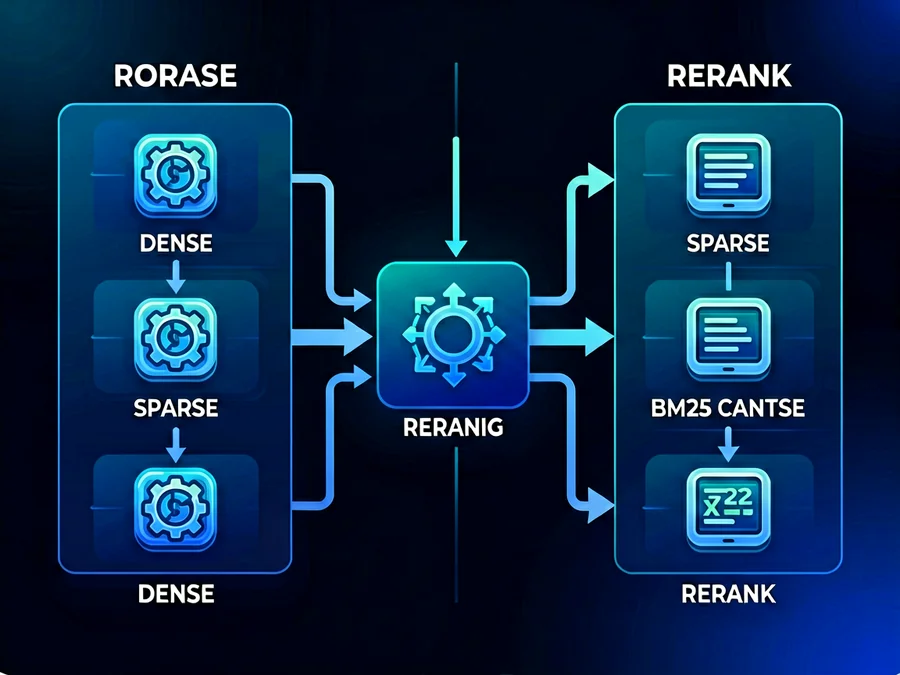
Simple vector similarity search is rarely sufficient for production RAG. Advanced retrieval architectures combine multiple signals to surface the most relevant context.
Sparse + Dense Hybrid Retrieval
Combining dense vector search with sparse lexical search (BM25) captures both semantic similarity and exact keyword matches. This hybrid approach is particularly effective for:
- Technical documentation with precise terminology
- Queries containing product names, version numbers, or acronyms
- Multi-language content where embeddings may be weaker
Tools like Elasticsearch, OpenSearch, or Weaviate support hybrid search natively, returning a weighted combination of dense and sparse scores.
Multi-Query Retrieval
Instead of embedding a single query, generate multiple query variants and retrieve from each. This technique, popularized by Google’s HyDE (Hypothetical Document Embeddings) approach, improves recall by capturing different aspects of the user’s intent.
For AI agents, multi-query retrieval is especially valuable when the agent needs to synthesize information from multiple document sections. The agent can generate specialized sub-queries for each retrieval round.
Metadata-Filtered Retrieval
When your knowledge base contains documents from different domains, time periods, or access levels, metadata filtering constrains retrieval to relevant subsets. This improves both precision and cost by reducing the vector space searched.
Common metadata filters include:
- Document type (policy, tutorial, reference)
- Creation date or version
- Author or department
- Access control labels
Reranking: The Critical Missing Step
Most RAG implementations skip reranking, accepting whatever the initial retrieval returns. This is a significant quality gap. Reranking uses a more sophisticated model to re-score initial retrieval candidates, promoting truly relevant documents while demoting false positives.
Cross-Encoder Reranking
Cross-encoders process the query and document together through a transformer model, producing a relevance score. While computationally expensive (they cannot use vector indexes), they excel at understanding nuanced relevance that bi-encoder embeddings miss.
Production workflows typically retrieve 50–100 candidates with dense/sparse search, then rerank the top 10–20 with a cross-encoder before passing to the LLM.
Reranking Models
| Model | Speed | Accuracy | License |
|---|---|---|---|
| BGE-Reranker-V2-M3 | Fast | High | MIT |
| cohere-rerank-english | Medium | Very high | Commercial |
| jina-reranker-v2 | Fast | High | Apache 2.0 |
Evaluation Metrics That Matter
Measuring RAG quality requires evaluating both retrieval and generation components separately.
Retrieval Metrics
- Recall@K: Percentage of relevant documents found in top K results
- NDCG@K: Normalized discounted cumulative gain accounts for ranking position
- MRR: Mean reciprocal rank measures how quickly relevant results appear
Generation Metrics
- Faithfulness: Whether generated claims are supported by retrieved context
- Answer relevance: How well the response addresses the original question
- Context utilization: Percentage of retrieved context actually used in generation
End-to-End Evaluation
For production AI agents, synthetic evaluation datasets are essential. Create question-answer pairs from your knowledge base, then measure:
- Percentage of questions answered correctly
- Average response latency including retrieval
- Cost per query including embedding and generation
- User satisfaction ratings on sampled responses
Common RAG Implementation Pitfalls
Even experienced teams encounter these recurring issues when deploying RAG systems for AI agents.
Pitfall 1: Ignoring Query Transformation
Raw user queries rarely match document language. Effective RAG systems transform queries before retrieval—expanding abbreviations, converting to search-friendly formats, or generating hypothetical answers that match documentation style.
Pitfall 2: Over-Chunking or Under-Chunking
Chunks that are too small lose context; chunks that are too large dilute relevance signals. Monitor retrieval quality across different chunk sizes and adjust based on your document structure.
Pitfall 3: Static Embedding Cutoffs
Using a fixed similarity threshold (e.g., cosine similarity > 0.7) often fails across diverse document types. Consider dynamic thresholds based on query difficulty or implement fallback strategies for low-confidence retrievals.
Pitfall 4: Forgetting Context Window Limits
Retrieved context must fit within the LLM’s context window after accounting for the system prompt, conversation history, and output requirements. Implement context budgeting to prevent truncation errors.
Production Deployment Checklist
| Component | Checklist Item |
|---|---|
| Vector Database | Scalable indexing, fault tolerance, metadata filtering support |
| Embedding Pipeline | Batched processing, incremental updates, model versioning |
| Retrieval Layer | Hybrid search, reranking, fallback strategies |
| Context Management | Chunk size optimization, overlap tuning, deduplication |
| Evaluation | Synthetic test sets, monitoring dashboards, A/B testing framework |
| Cost Control | Embedding cost optimization, caching frequent queries, rate limiting |
FAQ
How many documents should I embed for optimal retrieval?
Vector search performance degrades gracefully up to millions of documents with proper indexing. For AI agents, focus on retrieval quality rather than limiting document count. Use approximate nearest neighbor indexes like HNSW for sub-second lookup at scale.
Should I use commercial or open-source embedding models?
Commercial models like text-embedding-3-large offer superior accuracy but incur per-token costs. Open-source alternatives like BGE or Nomic are cost-effective for high-volume deployments and can run locally. Test both on your specific document corpus before committing.
How do I handle outdated or deprecated documentation?
Implement version tracking in your metadata and prioritize recency during retrieval. Set expiration dates for time-sensitive documents and flag stale content in retrieval results. Consider maintaining separate indexes for current vs. archived documentation.
What context window size should I target?
Balance retrieval recall against generation quality. Smaller contexts (4K–8K tokens) tend to produce more focused responses but may miss important details. Larger contexts (16K–32K) improve recall but increase cost and latency. Start with 8K tokens and expand only if evaluation shows recall deficits.
How do I evaluate RAG quality without human annotators?
Use synthetic evaluation datasets created from your own documentation. Generate question-answer pairs, then measure retrieval recall and generation faithfulness. Tools like RAGAS and DeepEval automate this evaluation pipeline and provide composite quality scores.
Getting Started with SmaugBrain
SmaugBrain provides the infrastructure for production AI agents that need robust RAG capabilities. Our agent framework supports custom tool integration, enabling you to build retrieval-augmented workflows that scale from prototype to production.
Learn more about SmaugBrain and start building production AI agents today.
Key Takeaways
- Chunking strategy matters more than you think: Semantic and multi-granularity chunking significantly outperform fixed-size approaches for complex documents.
- Hybrid retrieval is essential: Combine dense vector search with lexical BM25 for best recall across diverse query types.
- Always rerank: Cross-encoder reranking of top candidates dramatically improves final retrieval precision.
- Measure what matters: Track both retrieval metrics (recall, NDCG) and generation metrics (faithfulness, relevance) separately.
- Transform queries before retrieval: Raw user queries often fail to match documentation language; invest in query expansion and transformation.
Building effective RAG systems requires iterative refinement across chunking, retrieval, and reranking components. Start with a simple implementation, establish baseline metrics, and optimize each component systematically based on your evaluation results.