
AI Agent Testing and Validation: A Production Checklist for Reliable Systems
Building an AI agent that works in a demo environment is fundamentally different from shipping one that runs reliably in production. Unlike traditional software, AI agents introduce probabilistic behavior, dynamic context dependencies, and multi-step tool orchestration that make standard QA approaches insufficient. This guide provides a production-tested checklist for validating AI agent systems before they touch real users or critical infrastructure.
Why AI Agents Require Specialized Testing
Traditional software follows deterministic logic: input A plus rules B always produces output C. AI agents operate differently. They consume unstructured inputs, call external tools with variable responses, manage volatile conversation history, and make autonomous decisions within configured guardrails. Each of these dimensions introduces failure modes that static test suites cannot easily catch.
Consider a customer support agent that retrieves order details, checks inventory systems, and drafts refund responses. The LLM might hallucinate an order number when the retrieval tool times out. It might invoke the payment API with malformed parameters after misreading a long conversation thread. It could follow a fallback path that escalates incorrectly because the confidence threshold was tuned too aggressively. These are not edge cases — they are expected behaviors in probabilistic systems.
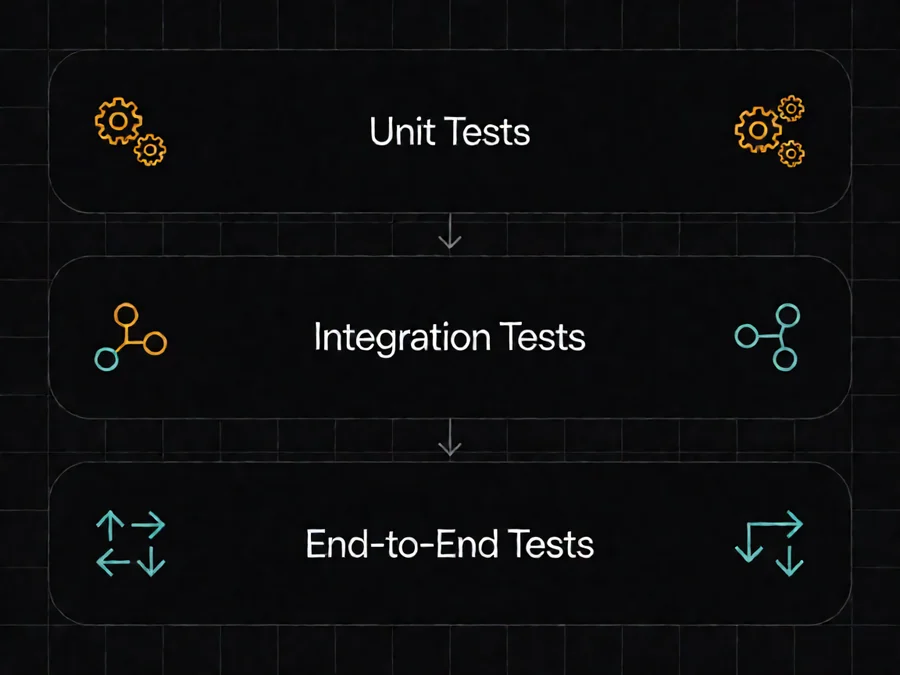
Production testing must therefore address three distinct layers: tool reliability, decision logic, and end-to-end workflow correctness. Ignoring any layer creates blind spots that surface only after deployment, when user trust and revenue are already at risk.
Testing Tool Integration Reliability
AI agents depend on external systems for almost all meaningful operations. Your validation must prove that each tool call behaves correctly across expected and unexpected conditions.
Unit Testing Individual Tool Calls
Each tool function — whether it queries a database, calls an API, or reads a file — should have isolated tests that verify correct input formatting, error handling, and response parsing. Focus on boundary conditions: empty results, network timeouts, rate limits, and malformed responses from downstream services.
Test both the happy path and failure modes. When an external API returns a 503 error, does your agent retry with backoff? When a database query returns no results, does it handle the empty set gracefully rather than crashing or hallucinating content?
Mocking External Dependencies
Production environments contain unpredictable systems. Use mocking libraries to simulate tool responses during testing, allowing you to exercise every branch of your agent’s logic without depending on live services. Mock slow responses to test timeout handling, mock rate-limit headers to verify retry logic, and mock error responses to confirm fallback pathways.
Document which tools are mocked and why. When you later migrate a test from mocked to real dependencies, the documentation becomes your migration checklist.
Contract Testing for Tool APIs
When your agent calls third-party APIs, implement contract tests that verify the provider’s actual response schema matches your parser’s expectations. API providers occasionally change response formats, add new fields, or deprecate existing ones. Contract tests catch these changes before they break your agent in production.
Schedule contract tests to run hourly or daily, not just at deployment time. A third-party API change at 3 AM is far more disruptive than one caught during business hours.
Validating Decision Logic and Fallback Behavior
AI agents make autonomous decisions based on LLM outputs, confidence scores, and configured policies. These decisions must be validated for correctness, safety, and compliance with your business rules.
Confidence Threshold Testing
Most production agents use confidence scoring to decide whether to proceed autonomously or escalate to human review. Test the threshold boundaries extensively. Create scenarios where the agent should confidently proceed, scenarios where it should defer, and edge cases where confidence hovers near the threshold.
Measure how often the agent escalates unnecessarily — this creates user friction — versus how often it proceeds despite low confidence — this creates reliability risk. Tune thresholds based on these measurements, not intuition.
Fallback Path Coverage
Every autonomous decision should have a tested fallback. If the primary LLM call fails, does the agent use a fallback model? If a tool returns an error, does it retry with adjusted parameters or escalate? If multiple tools are required and one fails, does the agent complete partial results or abort cleanly?
Map your fallback decision tree on paper before writing tests. Each branch should have at least one test case that exercises the fallback logic with realistic inputs.
Guardrail Verification
Production agents require guardrails that prevent unauthorized actions, data exposure, or policy violations. Test each guardrail independently and together. Verify that role-based access controls prevent agents from performing operations outside their permissions. Confirm that sensitive data patterns trigger redaction before the data reaches the LLM context.
Hallucination Detection
LLM hallucinations remain the most persistent production risk. Implement structured validation that checks agent outputs against ground truth whenever possible. When calling retrieval tools, verify that cited sources actually exist and contain the claimed information. When generating structured data, validate against JSON schemas and business rules.
Consider adding a separate validation step that reviews the agent’s output for internal consistency before presenting it to users. This second-check layer catches contradictions, missing fields, and format violations that the primary generation might miss.
End-to-End Workflow Testing
Individual component tests prove that parts work correctly in isolation. End-to-end tests prove that the entire agent workflow functions as designed when processing realistic user requests through to completion.
Scenario-Based Test Suites
Build test scenarios that mirror actual user workflows. A support agent scenario might include: user asks about order status, agent retrieves order details, user asks to modify shipping, agent verifies address changes, user confirms, agent updates system and sends confirmation. Each scenario should have expected outputs at every step, not just the final result.
Include negative scenarios too: user asks an unsupported question, user provides incomplete information, user requests something outside policy bounds. These scenarios often reveal gaps in your fallback logic that positive cases hide.
Replay Testing with Real Interactions
Capture anonymized production interactions and replay them through your test environment. This technique reveals issues that synthetic tests cannot reproduce because it uses real user language, real tool call patterns, and real error conditions. Schedule regular replays as part of your CI pipeline to catch regressions early.
Maintain a library of representative interactions organized by scenario type and outcome. Update the library continuously as new interaction patterns emerge in production.
Performance Testing Under Load
AI agents behave differently under load than in isolation. Token consumption increases, context windows fill faster, tool call queues back up, and cost scaling becomes apparent. Test your agent under realistic concurrent load to measure response time degradation, error rate increases, and cost per transaction.
Establish performance baselines and monitor them continuously. When response times increase or error rates climb beyond acceptable thresholds, your monitoring should alert you before users notice the degradation.
Monitoring and Observability in Production
Testing validates that your agent works correctly before deployment. Monitoring proves that it continues to work correctly after deployment. Production observability is not optional — it is the feedback loop that closes the validation cycle.
Structured Logging for Agent Operations
Log every significant agent operation with structured metadata: request ID, user ID, tool calls made, LLM model used, token counts, confidence scores, and decision points. Structured logs enable querying and analysis that unstructured logs cannot support.
Include timing data in every log entry to identify performance bottlenecks. When response times degrade, structured timing logs let you isolate whether the delay occurred in the LLM call, tool invocation, or orchestration logic.
Tracing Agent Execution
Implement distributed tracing that follows a single user request through every LLM call, tool invocation, and decision point. Tracing reveals execution paths that logs alone cannot capture, including parallel tool calls, retry attempts, and fallback activations.
Use trace data to identify common failure patterns and optimize the most frequently traversed paths. When a particular tool integration consistently causes latency or errors, the trace data shows exactly where and how often.
Anomaly Detection and Alerting
Define normal behavior baselines for your agent’s key metrics: response time percentiles, error rates by tool, confidence score distributions, and escalation frequency. Detect deviations from these baselines using statistical methods or simple threshold rules.
Alert on anomalies that indicate real problems: sudden increases in tool errors, confidence scores dropping below acceptable levels, unexpected escalation patterns, or token consumption spikes that suggest inefficient prompting. Distinguish between actionable anomalies and expected variance to avoid alert fatigue.
Cost Monitoring and Optimization
AI agent costs scale directly with usage patterns. Monitor token consumption per transaction, per user, and per tool category. Identify expensive patterns — long context windows, repeated retries, inefficient tool combinations — and optimize them proactively.
Set cost budgets and alerts that trigger before spending becomes problematic. Unexpected cost spikes often indicate a logic error, such as an infinite retry loop or a tool that returns unexpectedly large responses.
Security and Compliance Validation
Production AI agents handle sensitive data and perform actions that affect real systems. Security and compliance testing must be as rigorous as functional testing.
Prompt Injection Defense
Test your agent against common prompt injection attacks: direct attempts to override instructions, indirect injection through retrieved content, and multi-turn attacks that build manipulation across conversation context. Verify that your guardrails detect and block these attacks without interfering with legitimate user requests.
Update your injection test suite regularly as new attack techniques emerge. Prompt injection is an adversarial domain where defenders must continuously adapt.
Data Loss Prevention
Validate that your agent correctly identifies and redacts sensitive data patterns: PII, payment card numbers, API keys, and proprietary business information. Test with realistic data samples and verify that redaction occurs before data enters the LLM context window.
Implement DLP rules at multiple layers: input validation, context construction, and output filtering. Multiple defense layers ensure that a bypass in one layer does not expose sensitive data.
Access Control Testing
Verify that your agent respects user permissions and role-based access controls. Test that users cannot access data or perform operations outside their authorization scope, even when the LLM might naturally suggest such actions based on the conversation context.
Audit access control logs regularly for anomalies that suggest privilege escalation attempts or configuration errors.
Continuous Validation and Improvement
AI agent systems evolve continuously: new tools get added, LLM models get updated, user expectations change, and failure modes shift. Your validation strategy must evolve with the system rather than remaining static.
Regression Testing for Agent Changes
Every code change, configuration update, or model upgrade should run the full regression test suite before deployment. Agent systems are particularly sensitive to changes because small modifications can have disproportionate effects on behavior due to the complex interaction between LLM reasoning, tool calling, and context management.
Maintain versioned test suites that document the expected behavior at each release. When a regression appears, the versioned tests help you understand what changed and why.
A/B Testing New Behaviors
When evaluating significant behavioral changes — new tool integrations, modified fallback logic, updated prompting strategies — use A/B testing to compare performance against the current production baseline. Measure not only accuracy and user satisfaction but also cost, latency, and error rates.
A/B test incrementally. Roll out changes to a small traffic percentage first, observe the metrics, and expand gradually. Sudden large-scale changes in probabilistic systems often reveal problems that gradual rollout catches earlier.
Post-Incident Review and Lesson Integration
Every production incident is an opportunity to improve your validation strategy. Conduct structured post-incident reviews that identify what testing should have caught the issue, why it was not caught, and what preventive measures to add.
Update your test suites, monitoring alerts, and deployment checklists based on post-incident findings. Track the effectiveness of these updates over time to ensure the review process drives real improvement rather than becoming a ritual without impact.
Conclusion
Production AI agent validation requires a multi-layered approach that addresses tool reliability, decision logic correctness, end-to-end workflow integrity, operational observability, and security compliance. No single testing technique captures all failure modes; the combination of unit tests, integration tests, scenario-based validation, production monitoring, and continuous improvement processes creates defense in depth.
Start with the checklist items most relevant to your current system, measure your coverage honestly, and prioritize gaps that pose the highest risk. Agent validation is not a one-time project but an ongoing discipline that strengthens as your system matures and your understanding of failure modes deepens. The agents that reach production reliably are the ones whose teams treat validation as a continuous practice rather than a pre-launch gate.