
Agentic RAG in Production: Building Self-Correcting Retrieval Systems That Actually Work
Traditional Retrieval-Augmented Generation (RAG) follows a fixed pipeline: embed a query, retrieve top-k chunks, inject them into a context window, and generate. It works well for simple document Q&A—but breaks down when a question requires multiple reasoning steps, source cross-validation, or adaptive retrieval strategies.
Agentic RAG addresses these limitations by replacing static pipelines with autonomous, decision-making agents that plan retrievals, critique outputs, rewrite queries, and iterate until confidence thresholds are met. This guide covers the architectures, failure modes, and production patterns teams need to move from prototype to reliable deployment.
Why Traditional RAG Fails in Production
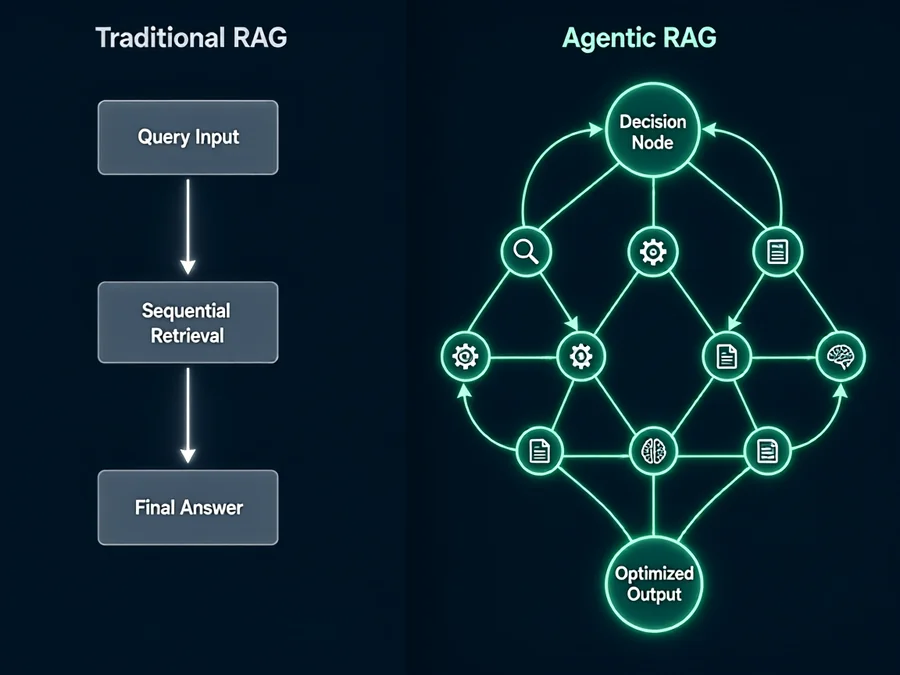
The gap between a RAG proof-of-concept and a production system usually comes down to three structural weaknesses:
| Failure Mode | Traditional RAG | Agentic RAG |
|---|---|---|
| Single-shot retrieval | Fails once, returns best guess | Rewrites query, retries with different strategy |
| No source validation | Generates from retrieved chunks unconditionally | Critic agent checks claims against evidence |
| Fixed context budget | Everything goes into one prompt | Prioritizes relevant chunks, discards noise |
| No multi-hop reasoning | One retrieval pass only | Plans chain of retrievals across sources |
| Static embedding quality | Relies on single embedding model | Adapts embedding strategy per query type |
Each of these failure modes has a direct cost in production: hallucinated answers, wasted token spend on irrelevant context, and increased latency from blind re-retrievals without strategy changes.
Core Architectures for Agentic RAG
Production agentic RAG systems typically follow one of four architectural patterns, each suited to different reliability and latency requirements.
Pattern 1: Sequential Reflection Loop
A single agent executes a generate-critique-revise cycle. After each generation, a reflection step evaluates answer quality against retrieval evidence. If confidence falls below threshold, the agent rewrites the query or fetches additional documents before regenerating. This pattern is simplest to implement and debug but incurs linear latency overhead from repeated passes.
Pattern 2: Parallel Multi-Agent Retrieval
Multiple specialized agents run concurrent retrieval strategies—a semantic search agent, a keyword extraction agent, and a knowledge-graph traversal agent—all querying different sources simultaneously. A synthesizer agent merges results, resolves conflicts, and produces the final output. This pattern reduces latency for complex queries at the cost of higher token consumption and coordination complexity.
Pattern 3: Tool-Augmented Graph RAG
The agent treats retrieval as tool use rather than a builtin step. Each retrieval call is a discrete action with observable side effects: source metadata, citation count, relevance score. The agent builds a dynamic execution graph where nodes represent retrieval actions and edges represent logical dependencies. This enables conditional branching—agent loops that skip irrelevant retrieval paths—and produces an audit trail useful for debugging and compliance.
Pattern 4: Hierarchical Agent Delegation
An orchestrator agent decomposes a complex query into sub-queries, delegates each to a specialist agent, and aggregates results. Sub-agents may themselves spawn further retrieval chains. This mirrors how human research teams operate and scales well to enterprise document corpora with thousands of sources. The trade-off is longer end-to-end latency and more points of failure.
Implementation Checklist: From Prototype to Production
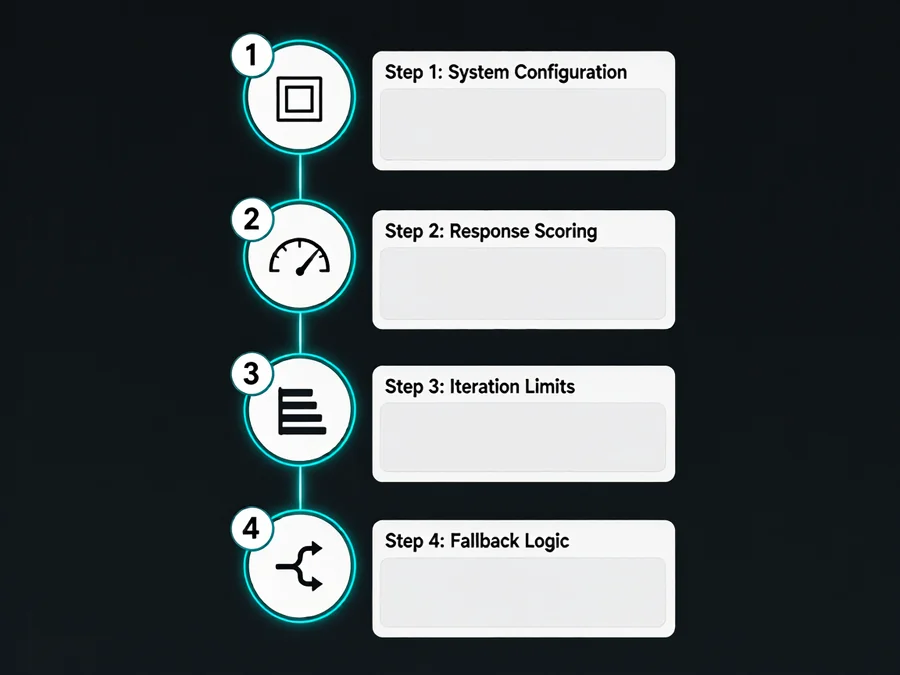
Moving an agentic RAG system from notebook experiment to production service requires explicit attention to six operational dimensions that most tutorials overlook.
- Retrieval strategy configuration: Define which retrieval tools each agent can call (vector search, full-text search, knowledge graph traversal, API calls) and set per-tool timeout and result-count limits.
- Confidence scoring: Implement a scoring function that rates retrieved evidence quality before generation begins. Common signals include cosine similarity distribution, source recency, and cross-source agreement.
- Maximum iteration bounds: Every reflection loop needs a hard ceiling—typically 3–5 iterations—to prevent runaway token costs. Log exceeded iterations separately so you can identify systematically difficult queries.
- Fallback on exhaustion: When all retrieval strategies are exhausted without sufficient confidence, fall back to a transparent insufficient-evidence response rather than generating a speculative answer.
- Citation enforcement: Require every generated claim to include a verifiable source reference. Strip or flag uncited assertions before returning results to users.
- Observability hooks: Instrument each agent step with structured logs capturing: agent role, retrieval strategy used, chunks fetched, confidence scores, and decision rationale. Without this visibility, debugging production failures becomes impossible.
Build production-ready agentic RAG systems with SmaugBrain — explore our cloud AI agent platform →
Cost and Latency Management in Agentic RAG
Agentic RAG inherently consumes more tokens than traditional RAG because of iterative retrieval and reflection. Understanding the cost structure prevents surprise bills and helps teams size their deployments correctly.
The primary cost drivers break down into three categories: retrieval token usage (embedding vectors and chunk text), generation token usage (multiple draft responses during reflection loops), and orchestration token usage (agent routing decisions and conversation history management). A typical multi-agent RAG query can consume 3–10× more tokens than a single-pass RAG query, depending on iteration depth and parallelism level.
Effective cost controls include aggressive chunk deduplication across retrieval rounds, caching repeated query embeddings, and implementing early-exit logic when confidence thresholds are met before exhausting all iterations. Teams that monitor per-query cost distributions typically find that 80% of queries resolve within two retrieval rounds while 5% consume disproportionate resources—these outliers deserve separate handling with stricter iteration limits or human escalation.
Common Pitfalls and How to Avoid Them
Even well-designed agentic RAG systems encounter predictable failure patterns in production. Recognizing these patterns early saves significant rework.
Pitfall 1: Over-retrieval loops. When confidence thresholds are set too aggressively, agents enter endless retrieval cycles that burn tokens without improving answer quality. Fix this by introducing diminishing returns weighting—each successive retrieval round contributes less to the final confidence score, naturally converging toward termination.
Pitfall 2: Source contamination. In multi-source environments, documents from one domain can contaminate retrieval for another. For example, legal precedent passages leaking into product documentation queries. Fix this with strict namespace isolation per retrieval tool and cross-namespace conflict resolution rules.
Pitfall 3: Reflection trap. When critic agents become overly harsh, valid answers get rejected repeatedly, causing unnecessary regeneration cycles. Calibrate criticism sensitivity using held-out evaluation sets that measure both precision (are rejected answers actually wrong?) and recall (are accepted answers actually right?).
Pitfall 4: Context window saturation. Agentic RAG frequently pushes large amounts of retrieved context into LLM windows. Monitor remaining context budget continuously and implement sliding-window truncation that preserves the most recent and highest-confidence chunks while discarding redundant earlier retrievals.
Frequently Asked Questions
What distinguishes agentic RAG from standard RAG?
Standard RAG follows a fixed sequence: retrieve then generate. Agentic RAG adds autonomous decision-making—agents choose which retrieval strategies to apply, iterate based on quality feedback, validate sources independently, and can abandon low-confidence paths entirely. The key difference is adaptability versus rigidity under uncertainty.
Is agentic RAG worth the additional complexity?
It depends on your use case. For straightforward document lookup with high-volume similar queries, traditional RAG is sufficient and cheaper. Agentic RAG becomes worthwhile when queries require multi-step reasoning, source cross-validation, or handle highly variable question types where a single retrieval strategy consistently fails.
How do you evaluate agentic RAG quality?
Beyond standard metrics like answer correctness and retrieval accuracy, agentic RAG requires process-aware evaluation: measure whether the agent chose appropriate retrieval strategies, whether reflection loops converged efficiently, and whether the system gracefully degraded when evidence was insufficient. Track per-query iteration counts alongside answer quality to detect systematic failures.
What infrastructure is needed for production agentic RAG?
Production agentic RAG requires vector database infrastructure for dense retrieval, a message queuing system for coordinating parallel agent tasks, structured logging for observability across agent steps, and rate limiting policies to control token spend. Cloud AI agent platforms like SmaugBrain abstract much of this infrastructure away, letting teams focus on retrieval logic rather than platform engineering.
Can agentic RAG handle real-time data updates?
Yes—one of the main advantages over fine-tuned approaches is that agentic RAG retrieves live data at query time rather than relying on static training snapshots. However, this requires the underlying data sources to expose stable APIs or streaming endpoints that agents can query reliably. Document ingestion pipelines should run on independent schedules from agent query processing to avoid consistency conflicts.
How does agentic RAG relate to MCP (Model Context Protocol)?
MCP provides standardized tool interfaces that agentic RAG systems can leverage for retrieval operations. An agent using MCP can discover and invoke diverse retrieval tools—from vector databases to web search APIs—through a consistent protocol, simplifying the integration of new data sources without rewriting agent logic.
When should you choose hierarchical delegation over parallel retrieval?
Use hierarchical delegation when queries have clearly decomposable sub-components (e.g., compare regulatory requirements across EU, US, and APAC markets) where each sub-query benefits from focused expertise. Use parallel retrieval when the question requires synthesizing information from many independent sources simultaneously without a natural decomposition structure.
Conclusion
Agentic RAG represents a fundamental shift from static retrieval pipelines to adaptive, self-correcting systems. By treating retrieval as a planning problem rather than a fixed step, these systems deliver higher accuracy on complex queries and graceful degradation when evidence is insufficient. The trade-offs—higher token costs, increased latency, and greater implementation complexity—are real but manageable with careful architecture choices and operational discipline.
Teams entering agentic RAG should start with a narrow high-value use case, instrument every retrieval decision, and establish clear exit criteria for reflection loops. The goal is not the most sophisticated agent architecture but the simplest system that reliably answers the target questions within acceptable cost and latency bounds.