
AI Agent Decision Intelligence: How to Make Smarter Choices in Autonomous Systems
Every AI agent faces a fundamental challenge: how to make optimal decisions when operating in complex, uncertain environments. Should it explore new strategies or exploit known ones? Should it act immediately or gather more information? The answer depends on the task, the cost of errors, and the value of information.
This guide explores decision intelligence for AI agents — the frameworks, algorithms, and practical patterns that help autonomous systems choose wisely. We’ll cover exploration-exploitation tradeoffs, decision trees, utility theory, multi-armed bandits, and real-world implementation patterns used in production systems.
Why Decision Intelligence Matters for AI Agents
Unlike traditional software that follows deterministic rules, AI agents must make decisions under uncertainty. They face incomplete information, competing objectives, and time pressures. Good decision-making separates agents that reliably achieve their goals from those that waste resources or make catastrophic errors.
Decision intelligence combines insights from operations research, machine learning, and cognitive science to build agents that:
- Balance exploration and exploitation — trying new approaches versus using proven strategies
- Quantify uncertainty — understanding when they don’t know enough to decide
- Evaluate tradeoffs — weighing speed against accuracy, cost against quality
- Learn from outcomes — improving decision-making through feedback loops
The Exploration-Exploitation Dilemma
The exploration-exploitation tradeoff is the central challenge in agent decision-making. Agents must decide whether to:
Exploit: Use known information to maximize immediate rewards. If an agent has discovered that Action A yields 10 points on average, exploiting means choosing Action A repeatedly.
Explore: Try unknown actions to gather information. Even if Action B currently appears worse, exploring it might reveal hidden opportunities worth pursuing.
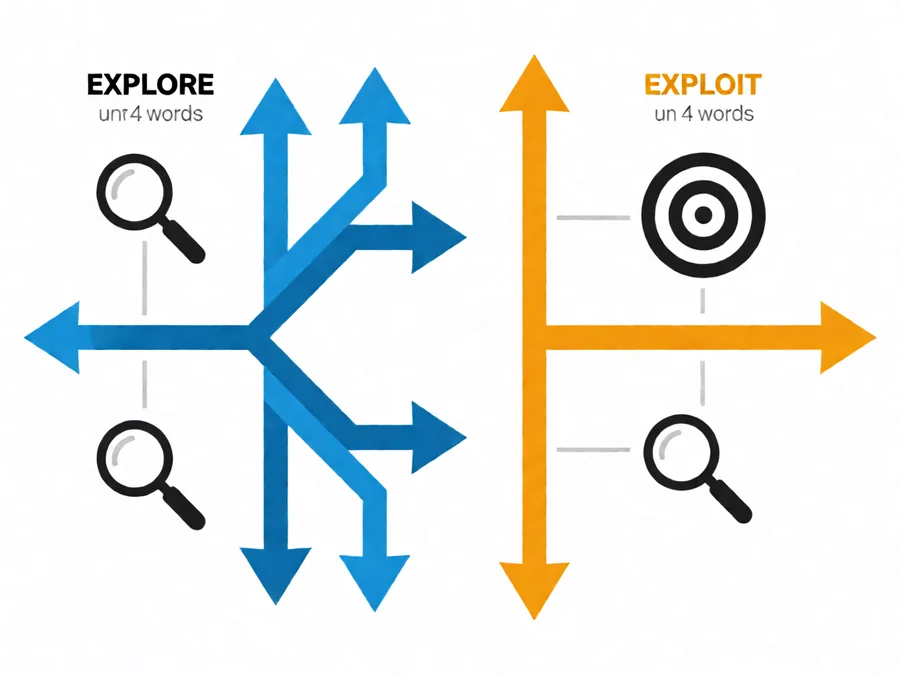
When to Explore vs. Exploit
The optimal balance depends on several factors:
- Time horizon: Agents with long-term objectives should explore more; short-term agents should exploit
- Cost of exploration: Expensive exploration requires stronger justification
- Uncertainty level: High uncertainty favors exploration
- Competition: In competitive environments, exploration can provide strategic advantage
Decision Frameworks for AI Agents
Multi-Armed Bandits
Multi-armed bandit problems model situations where an agent must choose between multiple options (arms) with unknown reward distributions. The classic example is a gambler at slot machines deciding which lever to pull.
Common algorithms:
- Epsilon-greedy: Choose the best-known action most of the time, but explore randomly with probability epsilon
- Upper Confidence Bound (UCB): Choose actions with high potential based on confidence intervals
- Bayesian methods: Maintain probability distributions over arm qualities and update with observations
Markov Decision Processes
Markov Decision Processes (MDPs) provide a mathematical framework for modeling decision-making in situations where outcomes are partly random and partly under the agent’s control. MDPs are fundamental to reinforcement learning and sequential decision-making.
Key components:
| Component | Description | Example |
|---|---|---|
| States (S) | All possible situations | Location, inventory level, system status |
| Actions (A) | Available decisions | Moves, tool calls, queries |
| Transitions (P) | Probability of state changes | Success rates, failure modes |
| Rewards (R) | Immediate feedback | Points, costs, user satisfaction |
Decision Trees
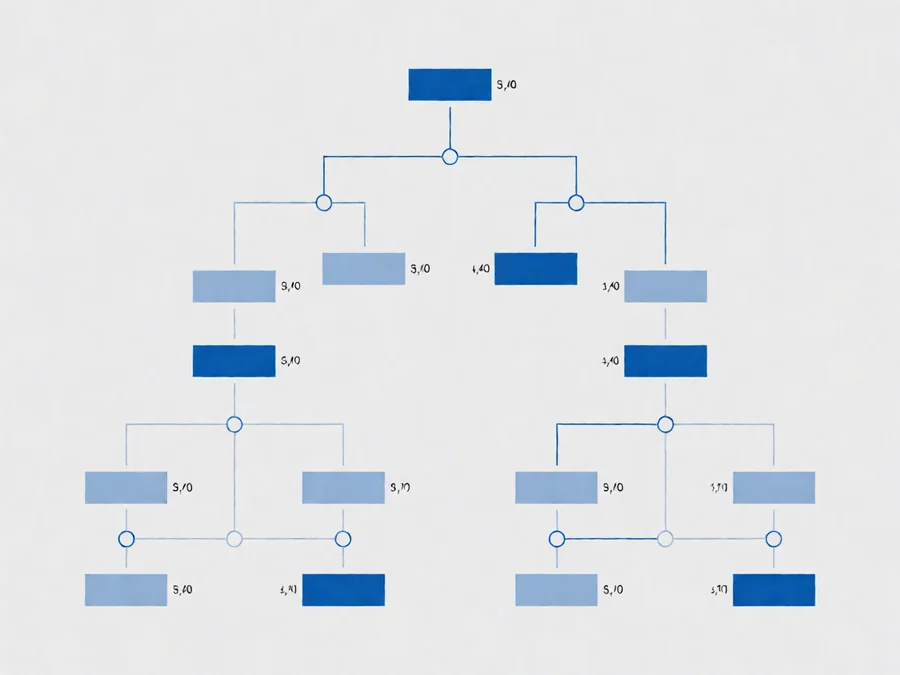
Decision trees provide interpretable frameworks for mapping out choices, outcomes, and probabilities. They’re particularly useful when agents need to explain their reasoning or when decisions involve clear branching logic.
Building effective decision trees:
- Start with the root decision node (the choice to make)
- Branch out to chance nodes (uncertain outcomes) and decision nodes (further choices)
- Assign probabilities to uncertain branches
- Calculate expected values at each node
Utility Theory and Value-Based Decisions
Utility theory provides a formal way to represent preferences and make rational decisions. Instead of comparing raw rewards, agents assign utilities to outcomes based on their desirability.
Key principles:
- Completeness: An agent can compare any two outcomes
- Transitivity: If A is preferred to B, and B to C, then A is preferred to C
- Continuity: There exists a utility value for every outcome
- Substitutability: Lotteries can be compared by expected utility
Practical application: When an agent faces competing objectives (speed vs. accuracy, cost vs. quality), utility functions help quantify tradeoffs. For example, a customer service agent might weight response time at 0.6 and accuracy at 0.4, combining them into a single decision score.
Risk Management in Agent Decisions
Not all decisions carry equal risk. Agents should calibrate their confidence and caution based on the stakes involved.
Risk-Averse vs. Risk-Seeking Strategies
Risk-averse agents prefer certain outcomes over gambles, even when the gamble has higher expected value. This approach suits scenarios where losses are catastrophic (financial trading, medical diagnosis).
Risk-seeking agents accept variance for potential higher rewards. This approach works when exploration could unlock breakthrough improvements (R&D, innovation tasks).
Risk-neutral agents maximize expected value without adjustment. This is the default assumption in many optimization frameworks.
Implementing Risk Awareness
Agents can incorporate risk management through:
- Value at Risk (VaR): Limit the probability of severe losses
- Conditional VaR: Optimize expected loss given that VaR is exceeded
- Robust optimization: Prepare for worst-case scenarios within uncertainty bounds
- Information value: Calculate whether gathering more data justifies the delay
Real-World Implementation Patterns
Pattern 1: Threshold-Based Decisions
Set confidence thresholds for different action types:
| Action Type | Confidence Threshold | Behavior |
|---|---|---|
| Critical execution | > 0.95 | Act only with high certainty |
| Important decisions | > 0.80 | Default to human escalation below threshold |
| Low-risk experiments | > 0.60 | Allow broader exploration |
Pattern 2: Adaptive Exploration
Dynamic exploration based on uncertainty:
- High uncertainty: Increase exploration rate (epsilon = 0.3)
- Medium uncertainty: Moderate exploration (epsilon = 0.1)
- Low uncertainty: Primarily exploit (epsilon = 0.01)
Pattern 3: Hierarchical Decision Making
Decompose complex decisions into layers:
- Strategic layer: Long-term objectives and resource allocation
- Tactical layer: Medium-term planning and workflow design
- Operational layer: Immediate actions and tool execution
Common Pitfalls and How to Avoid Them
Pitfall 1: Overfitting to Recent History
Agents that weight recent experiences too heavily may miss long-term patterns. Solution: use exponential moving averages or buffer-based memory that balances recency with stability.
Pitfall 2: Ignoring Opportunity Costs
Choosing one action prevents others. Agents should account for what they’re giving up, not just what they gain. Solution: maintain opportunity cost estimates alongside action values.
Pitfall 3: Confirmation Bias
Agents may seek information that confirms existing beliefs. Solution: actively query disconfirming evidence and weight contradictory data appropriately.
Pitfall 4: Analysis Paralysis
Spending too much time deciding delays action and misses opportunities. Solution: implement stopping rules that force decisions after bounded deliberation.
Evaluating Decision Quality
How do you know if an agent is making good decisions? Track these metrics:
- Outcome accuracy: How often decisions lead to desired results
- Resource efficiency: Cost per decision (compute, time, tokens)
- Adaptation speed: How quickly agents learn from feedback
- Error recovery: Ability to correct bad decisions
FAQ: AI Agent Decision Intelligence
How do I choose between exploration and exploitation?
Use the UCB algorithm for balanced exploration, or epsilon-greedy with adaptive epsilon based on uncertainty levels. In production, start with higher exploration (epsilon = 0.2) and decay over time as confidence builds.
What’s the difference between MDPs and decision trees?
MDPs handle sequential decisions with probabilistic transitions and are solved using dynamic programming. Decision trees are static representations of choices and outcomes, better for one-shot decisions or when interpretability matters more than optimization.
How do I handle conflicting objectives in agent decisions?
Assign weights to each objective and compute weighted utility. Alternatively, use Pareto optimization to find solutions that can’t improve one objective without worsening another. For simple cases, pick the primary objective and constrain others as hard limits.